Love, Divorce and the Second Act – A practical, reassuring guide to divorce later in life – emotionally and financially

“Grey divorce” is a phrase often used for divorce amongst couples of a certain age however behind the label is a deeply personal decision about the next stage of life.

For many couples, the most difficult part of divorce isn’t the paperwork, it’s acknowledging that the life you’ve built together is changing. When a relationship ends after many years, it can feel less like a clear ending and more like a transition: new routines, new financial realities and, often, a new sense of identity.
Separation after a long marriage is becoming increasingly common. As people live longer and reassess what they want from the years ahead, relationships sometimes evolve in unexpected ways. For some, it’s a gradual drifting apart, for others, a moment of clarity that what once worked no longer feels right.
Why do couples separate after a long marriage?
There is rarely a single reason. More often, it’s a combination of changes over time:
- Life after children – when children leave home, some couples realise their relationship has centred on parenting rather than partnership.
- Growing in different directions – interests, priorities and social circles can shift over time, particularly around retirement or career changes.
- Falling into routine – relationships can become practical and functional, rather than emotionally fulfilling.
- Looking ahead – many people reach a point where they feel unable to ignore long-standing unhappiness or a lack of connection, particularly when thinking about the future.
What can make later-life divorce more complex?
Whilst the emotional aspects of separation can be significant, it is often the financial considerations that feel most daunting. Decisions made at this stage can have a lasting impact, and there may be less time to rebuild financially.
Common areas to consider include:
- Income and future security – understanding what each person needs now, and in retirement, is essential.
- The family home – whether it is sold, retained or offset against other assets will affect long-term stability.
- Pensions – these are often substantial assets and may require specialist advice, particularly if they are already in payment.
- Businesses and investments – family businesses, property and shareholdings can introduce additional complexity, including tax considerations.
In England and Wales, the Family Court’s objective is to achieve a fair outcome. Whilst, a 50/50 division is often discussed as a starting point, it is not a fixed rule. The court will consider all the circumstances of the case, including each person’s needs, such as housing, income, health and any ongoing responsibilities.
It is also important to recognise that contributions to a marriage are not measured solely in financial terms. In long relationships, roles are often shared in different ways, earning, caring, managing the home and supporting each other’s careers all carry equal weight.
Taking early advice can help you understand what is realistic, avoid unnecessary disputes and make informed decisions about your future.

One Couple, One Lawyer: Collaboration not Conflict
If you’re considering a more amicable way to separate, the One Couple, One Lawyer approach could offer a practical alternative to the traditional divorce process. Instead of instructing separate solicitors, you and your partner work with one specially trained, neutral lawyer who helps you reach fair, informed decisions together. This collaborative model can reduce conflict, save time and costs, and help you move forward with dignity while keeping the focus firmly on your family’s future.
A Timely Reminder: Wills and Estate Planning
Separation is also an important point at which to review your Will and any beneficiary nominations, such as those linked to pensions or life insurance. These arrangements do not automatically update on divorce and reviewing them early can help ensure your wishes are properly reflected.
Taking the next step
If you are considering divorce after a long marriage, it is entirely normal not to have all the answers at the outset. An initial, supportive conversation can help you understand your options, the likely financial framework and the practical steps involved.
With the right advice, you can move forward with clarity and begin shaping the next chapter of your life with greater confidence.
If you would like tailored, practical guidance, the family team at Thornton Jones are here to help. We can advise you on the divorce process, likely financial outcomes (including pensions), and the steps you can take now to protect your position. Please get in touch to arrange a confidential initial appointment.

About the author
With more than 20 years’ experience at Thornton Jones, Stacey Higgs is a dedicated Family Paralegal supporting clients through divorce, mediation and children matters with compassionate, practical guidance every step of the way.
Protecting Your Finances During a Later Life Divorce
Divorce later in life can have a significant impact on your financial security, particularly where there are pensions, the family home, savings, investments, and inheritance considerations. Unlike younger couples, there is often less time to rebuild wealth before retirement, making it essential to obtain specialist legal advice as early as possible.
Every divorce is different, and reaching a fair financial settlement requires careful consideration of your individual circumstances. Factors such as the length of the marriage, each person’s financial needs, retirement plans, health, and future income will all play an important role.
At Thornton Jones Solicitors, we take a holistic approach to later life divorce. We don’t simply focus on achieving a financial settlement; we help you understand your options, protect your long-term financial wellbeing, and plan for the future. Whether your concerns relate to pensions, property, maintenance, or preserving wealth for children and grandchildren, we provide clear, practical advice tailored to your circumstances.
If you are considering divorce later in life or have already begun the process, our experienced family law team can guide you through each stage with sensitivity and expertise.
Need Advice About Divorce in Later Life?
Ending a long marriage can be emotionally and financially challenging. Later life divorce often involves more complex financial arrangements than divorces involving younger couples, making it particularly important to receive specialist legal advice before making any decisions.
At Thornton Jones Solicitors, our experienced Family Law team can advise you on every aspect of divorce and financial settlement, including:
- Explaining the divorce process and what to expect at each stage
- Advising on achieving a fair financial settlement following a long marriage
- Helping you understand how pensions may be valued and divided on divorce
- Advising on the future of the family home and other property assets
- Assisting with the division of savings, investments, businesses, and other valuable assets
- Advising on spousal maintenance and ongoing financial support where appropriate
- Helping protect inherited wealth and assets intended for children or grandchildren
- Supporting couples with blended families and complex financial circumstances
- Negotiating settlements through constructive discussions, mediation, or solicitor-led negotiation where appropriate
- Representing you in court proceedings if an agreement cannot be reached
- Providing clear, practical, and compassionate legal advice to help you move forward with confidence
A later life divorce can have a significant impact on your financial future, particularly where pensions, the family home, investments, and retirement income are involved. Obtaining timely legal advice can help you understand your rights and options, protect your long-term financial security, and work towards a fair financial settlement, allowing you to move forward with confidence.
Get in touch with our friendly and knowledgeable team today to discuss your options. You can call us on 01924 290 029 or contact us using our online enquiry form.
Divorce and Separation FAQs
The time it takes to get a divorce in England and Wales depends on your individual circumstances, but most straightforward divorces take around six to eight months to complete. Delays can occur if there are disagreements about finances or property, as these issues are dealt with separately from the divorce itself.
At Thornton Jones Solicitors, our experienced divorce solicitors will guide you through every stage of the divorce process, helping to minimise delays wherever possible while ensuring your interests are protected.
The cost of getting a divorce varies depending on whether it is amicable or involves disputes over finances. In addition to the court fee, you may also need to pay legal fees if you instruct a solicitor to manage your divorce or negotiate a financial settlement.
At Thornton Jones Solicitors, we provide clear, transparent advice on divorce costs from the outset. Wherever possible, we will discuss fixed-fee options and explain the likely costs involved, so you know what to expect before your case progresses.
Family mediation is a process where an independent, professionally trained mediator helps separating couples reach agreements about finances, property, or child arrangements without going to court. Mediation is often quicker, less stressful, and more cost-effective than court proceedings.
Before making most family court applications relating to children or finances, you are usually required to attend a Mediation Information and Assessment Meeting (MIAM) to find out whether mediation is suitable. There are some exceptions, such as cases involving domestic abuse or urgent applications.
Our family law solicitors at Thornton Jones Solicitors can advise whether mediation is appropriate in your circumstances and guide you through the next steps.
The content of this blog post is for information only and does not constitute formal legal advice and should not be relied upon as advice. Thornton Jones Solicitors Limited accepts no liability for any such reliance upon this content. Where the post includes links to external websites, Thornton Jones Solicitors Limited accepts no responsibility for the content of such sites. Any link to a third-party website should not be construed as endorsement by Thornton Jones Solicitors Limited of any content, products or services which are outside our direct control.
Divorce and Separation Solicitors
Government Cohabitation Consultation and the Rules of Intestacy

A lot of couples in England and Wales are part of the fastest-growing family type by being cohabitants. Despite this, the law has not kept up with what is going on in society especially in terms of inheritance. The Government has announced a consultation proposing major reforms to cohabitation law including how estates are dealt with under the rules of intestacy.

What is intestacy?
Intestacy is what happens to your estate when you die and do not have a legally valid Will specifying what should happen to your assets. Your assets will pass under statutory law rather than by your personal wishes. Intestacy rules establish a hierarchy of heirs which prioritises spouse/civil partner, children, parents and other relatives.
What would happen to my estate under the rules of intestacy?
People often think that unmarried cohabiting couples have the same rights as married couples when it comes to inheritance, but this is not the case. The intestacy rules are strict in that only spouses and civil partners have automatic rights to inheritance whereas cohabiting couples stand to inherit nothing regardless of how long they have been together. An estate would pass to the next living relatives such as children, parents or other surviving relatives, under the existing rules of intestacy.
What issues can arise to unmarried cohabiting couples under the rules of intestacy?
Families can face unnecessary stress especially if a surviving partner has been left financially vulnerable or at risk of losing their family home by not inheriting their partner’s estate.
Claims can be made by the surviving cohabiting couple under the Inheritance (Provision for Family Dependants) Act 1975 but these all depend on the circumstances and are often costly, time-consuming and can be uncertain.
The Government is now recognising that the law does not relate to the modern family life of cohabiting couples and explicitly states that the current law can leave bereaved partners with no inheritance which can create an unfair outcome and hardship.

BREAKING NEWS: Government Moves to Strengthen Rights for Unmarried Couples
The Government has launched a long-awaited consultation on cohabitation rights which is an important step towards better protection for unmarried couples. For family lawyers, this reform is overdue.
What changes will the reform bring to the rules of intestacy?
The consultation is proposing to reform the intestacy rules by changing automatic inheritance rules to include qualifying cohabitants under an eligibility criterion such as couples having lived together for a minimum time period and/or having had a child together. They are looking to reduce the reliance on court claims which can be costly and provide more certainty to cohabiting families.
The proposals will form part of a broader change to cohabiting couples who are undergoing a separation, divorce and other family law areas.
These proposed changes will be a big change and a potential sigh of relief to a lot of cohabiting couples however, they do not take effect yet and are only under consultation. When the reform will be implemented is unknown and what changes and criteria it will introduce remain uncertain.

Our thoughts on the proposed changes
Tara Carrington-fletcher, Private Client Team at Thornton Jones says: “These proposed reforms are a positive step towards recognising modern family life and could provide much-needed protection for cohabiting couples. Until any changes become law, unmarried partners remain vulnerable under the rules of intestacy, making a professionally drafted Will the best way to safeguard loved ones.”
What steps can I take to protect a cohabiting partner?
Whilst cohabiting couples remain unprotected under the rules of intestacy, we strongly recommend that any cohabiting couples should consider making a Will to ensure that their estates pass to who they want it to go to.
Wills are very important documents that ensure that your assets pass how you want them to go. Not a lot of people consider the consequences of not having a Will and just automatically assume that under intestacy, their assets will pass where they want them to go to but, especially where cohabiting couples are concerned, this is not always the case.
When preparing Wills at Thornton Jones, we look not only at the distribution of your assets, but also the best way to make your estates tax efficient and assist with planning for the future. We ensure that all aspects of your estate are covered and provide the relevant advice for lifetime planning.
If you could benefit from having a Will prepared or have any queries about the process, please get in contact with us to arrange an initial appointment.
Need Advice About Cohabitation and the Rules of Intestacy?
If your partner has died without leaving a valid Will, understanding how the rules of intestacy apply to cohabiting couples can be particularly challenging. Unlike married couples and civil partners, unmarried partners do not automatically inherit under the rules of intestacy, regardless of how long they lived together or whether they shared children. Seeking legal advice as early as possible can help you understand your rights and explore the options available.
At Thornton Jones Solicitors, our experienced Wills, Trusts and Probate team can explain how the rules of intestacy apply to cohabiting couples and guide you through the estate administration process. We can assist by:
- Explaining how the rules of intestacy affect unmarried couples when there is no valid Will
- Advising whether you have any legal entitlement to inherit from an intestate estate
- Assessing whether you may be able to bring a claim under the Inheritance (Provision for Family and Dependants) Act 1975
- Assisting with applications for a Grant of Letters of Administration where appropriate
- Advising personal representatives and administrators on their legal duties when administering an intestate estate
- Providing guidance where there are disputes between surviving partners, family members, or other beneficiaries
- Advising on complex family circumstances, including blended families, jointly owned property, and financial dependency
- Helping you understand the steps you can take to protect your partner and loved ones through effective estate planning and professionally drafted Wills
- Offering clear, practical, and compassionate legal advice to help you navigate the probate process with confidence
The rules of intestacy can have a significant impact on who inherits an estate when someone dies without a valid Will. Obtaining timely legal advice can help you understand your rights and responsibilities, ensure the estate is administered correctly, and avoid unnecessary delays or disputes during the probate process.
Get in touch with our friendly and knowledgeable team today to discuss your options. You can call us on 01924 290 029 or contact us using our online enquiry form.
Rules of Intestacy FAQs
No. Under the current law in England and Wales, cohabiting partners do not automatically inherit if their partner dies without a valid Will, regardless of how long they have lived together. Only spouses and civil partners have automatic inheritance rights under the rules of intestacy. If you are not married or in a civil partnership, it is important to have a professionally drafted Will to ensure your partner is provided for.
Yes, in some circumstances. A surviving cohabiting partner may be able to make a claim under the Inheritance (Provision for Family and Dependants) Act 1975 if they were financially dependent on the deceased or had lived together as a couple for the required period before death. However, these claims can be complex, costly, and there is no guarantee of success.
The Government has launched a consultation considering reforms to the rules of intestacy. The proposals include allowing certain qualifying cohabiting partners to inherit automatically where specific eligibility criteria are met, such as living together for a minimum period or having children together. The aim is to better reflect modern family life and reduce the need for court claims.
No. The proposed reforms are currently under consultation and have not become law. This means the existing rules of intestacy continue to apply, and cohabiting partners still have no automatic right to inherit if their partner dies without a valid Will.
The most effective way to protect a cohabiting partner is by making a valid Will. A Will allows you to decide who should inherit your estate, rather than relying on the rules of intestacy. It also provides an opportunity to consider inheritance tax planning, appoint executors, and ensure your wishes are clearly recorded, giving greater certainty for your loved ones.
The content of this blog post is for information only and does not constitute formal legal advice and should not be relied upon as advice. Thornton Jones Solicitors Limited accepts no liability for any such reliance upon this content. Where the post includes links to external websites, Thornton Jones Solicitors Limited accepts no responsibility for the content of such sites. Any link to a third-party website should not be construed as endorsement by Thornton Jones Solicitors Limited of any content, products or services which are outside our direct control.
Wills and Probate Solicitors
Can I Gift My Property to My Children to Reduce My Liability for Care Home Fees And Inheritance Tax?

One of our most frequently asked questions is whether it is possible to gift your property to your children in order to mitigate any care home fee liability or inheritance tax liability that you/your estate may incur in the future.

There are a number of reasons why you may be considering gifting your home, such as love and affection for the recipients of the gift or wanting to ensure that your children have the security of homeownership. You may be thinking about the effect that becoming your carer will have on your relative and you may feel morally obliged to provide for that person during your lifetime, or to ensure that the ongoing maintenance of the property can be carried out if age or ill health means this is something you struggle with.
Some people simply wish to simplify their estate administration upon death to take the pressure of their loved ones at an already distressing time.
Many people believe that if they gift their property to their children it is no longer considered as one of their assets. This is not always correct.
For many people, their main residence is their biggest asset and therefore it is understandable why people would wish to protect and preserve that asset as far as possible.
Can I Gift My Property to Reduce Care Home Fees?
Gifting your property to reduce any potential care home fees you may be required to pay in the future is risky.
One risk to consider is whether such a gift will be considered to be a deliberate deprivation of assets.
A deliberate deprivation of assets is when a person intentionally reduces their assets in an attempt to avoid such assets being used to pay for care fees.
There is no set timescale after which such a gift will be disregarded by the local authority. Instead, the local authority will need to consider whether, at the time the gift of the property was made, you had a reasonable expectation that you may need care, and may need to pay for that care in the future.
If it is found that you have deliberately deprived yourself of an asset, the local authority can include the value of the asset in their financial assessment and this may lead to financial complications.
Another misconception is that if a property is placed into a trust, that it will be protected from care fees, however this can also be seen as a deliberate deprivation of assets and there are also other factors to be considered such as loss of control over the property and the taxation of trusts.
Can I Gift My Property to Reduce Inheritance Tax
Gifting your property to avoid inheritance tax is another issue that we receive lots of questions about. As the main residence is such an important asset, many people wish to “gift” it to their children, but remain living in it and using it as though they still own it.
This is called a gift with reservation of benefit. This is where a person transfers the ownership of an asset on paper, but they continue to derive the benefit of the asset for themselves, as the legal owner would be entitled to do.
HMRC has very stringent rules around gifts with reservation of benefit and such gifts cannot be used as a way to avoid inheritance tax.
One way in which you can gift your property to your children is to make the gift a true gift, this would involve relinquishing all benefit and control over the property. This would be done by moving out of the property and living elsewhere, or paying the full market rent to your children (the legal owners of the property). If the gifted property was not your main residence, relinquishing control may take the form of not receiving the rental income from the property. For many people, these options are not possible, nor desirable.
Gifting property can have implications on inheritance tax if the giftor passes away within 7 years of making the gift.
If you were to pass away within 7 years of gifting a property, the property (or part of it, depending on how much time had passed) would be treat as though you were still the legal owner at the time of your death, and depending on the value of your assets, this could push you into inheritance tax, or increase your existing inheritance tax liability. This is known as “notional capital.”

Marriage Maths: Should You Get Married to Save Inheritance Tax?
Although marriage is often seen as a personal commitment, it can also be a practical financial arrangement. This is especially true when considering inheritance tax. The legal distinction between married and unmarried couples has significant consequences when it comes to estate planning. This article examines whether entering into a marriage or civil partnership could be a strategic step to mitigate inheritance tax liabilities and safeguard assets for future generations.
Other Reasons to Exercise Caution When Gifting a Property
You should consider what would happen to the property if the person you gifted it to encountered financial difficulties. This could mean that the property would be swallowed up by creditors, and if you were intending to remain living there, you could potentially be left without a home.
Similar concerns arise if the recipient of the property went through a divorce, and the property was taken into account in the divorce settlement. There is the risk that the property could be lost to a former spouse of the person that you gifted your home to.
If the recipient is in receipt of means tested benefits, the receipt of a significant asset, such as a property, is likely to affect their entitlement to benefits and this may have a negative effect on the recipient’s quality of life/lifestyle affordability. It also may mean that the recipient has unintended stamp duty consequences (such as loss of any available first-time buyer incentives) should the recipient purchase a property of their own in the future.
There are other ways in which you can ensure that your property passes to your children upon your death, or that you can rely on assistance from those you trust to assist you with managing and maintaining your property.
Should you wish to discuss estate planning and lifetime gifting, please contact us and we will be happy to assist and advise you further.
Contact our Estate Planning Solicitors today for advice
At Thornton Jones Solicitors, our specialist Private Client team provides clear, practical advice on all aspects of estate planning.
We can assist you with:
- Drafting and updating your Will to ensure your wishes are clearly set out
- Advising on inheritance tax planning and ways to protect your estate for future generations
- Setting up and advising on trusts to manage and safeguard assets
- Preparing Lasting Powers of Attorney (LPAs) for health, welfare, and financial decisions
- Structuring your estate to support asset protection and efficient distribution
- Advising on the appointment and responsibilities of executors and trustees
- Reviewing your assets to ensure your estate is accurately recorded and properly organised
Estate planning can be complex, particularly where family circumstances, tax considerations, or asset structures require careful thought. Our team provides tailored legal advice to help you plan with confidence and clarity.
To speak to our friendly Estate Planning team, please call 01924 290 029 or contact us using our online enquiry form.
Estate Planning Solicitors FAQs
Gifting your property to your children is sometimes considered as a way to reduce care home fees, but it is not guaranteed to be effective and can carry significant legal risks. Local authorities may treat this as a deliberate deprivation of assets if they believe the gift was made to avoid care costs. At Thornton Jones Solicitors, our Estate Planning Solicitors can advise you on the safest and most appropriate ways to protect your assets. Contact us today for clear, tailored legal advice.
Gifting your property may reduce inheritance tax in some circumstances, but strict HMRC rules apply, including the “gift with reservation of benefit” and the 7-year rule. If you continue to benefit from the property, it may still be included in your estate for tax purposes. Thornton Jones Solicitors can help you understand the tax implications and structure your estate effectively. Speak to our Estate Planning team today to plan ahead with confidence.
There are several risks, including loss of control over the property, exposure to your children’s financial difficulties, divorce settlements, or benefit implications, and potential tax consequences. Once gifted, you may also lose legal ownership and security. At Thornton Jones Solicitors , we provide practical Estate Planning advice to help you make informed decisions that protect both you and your family. Get in touch with our solicitors today to discuss your options.
The content of this blog post is for information only and does not constitute formal legal advice and should not be relied upon as advice. Thornton Jones Solicitors Limited accepts no liability for any such reliance upon this content. Where the post includes links to external websites, Thornton Jones Solicitors Limited accepts no responsibility for the content of such sites. Any link to a third-party website should not be construed as endorsement by Thornton Jones Solicitors Limited of any content, products or services which are outside our direct control.
Estate Planning Solicitors
Deeds of Variation vs. Deeds of Disclaimer

A Simple Guide for Beneficiaries in England and Wales
When you inherit from someone’s estate, you may find that the original distribution does not reflect your personal wishes, family circumstances, or financial priorities. In England and Wales, beneficiaries can use two main tools to change what happens to their inheritance.

These two tools are known as a Deed of Variation and a Deed of Disclaimer. Although they may appear similar, they operate quite differently. In this guide we explain each option in straightforward language so that you can easily tell the difference between a Deed of Variation and a Deed of Disclaimer.
What Is a Deed of Variation?
A Deed of Variation allows a beneficiary of an estate to legally redirect all or part of their inheritance to someone else. The Will, or Intestacy Rules if there is no Will, remain unchanged, but the beneficiary alters how their personal share is distributed.
What are the Key Features of a Deed of Variation
- You may redirect all or part of your inheritance to any person or charity
- It must be completed within two years of the date of death for tax efficiency purposes
- Often used for Inheritance Tax (IHT) or Capital Gains Tax (CGT) planning
Common Reasons to Use a Deed of Variation
- To improve tax efficiency within the estate
- To support family members who were left out of the Will
- To correct imbalance or help maintain family harmony
- You want flexibility in how the estate is shared
- You want to reduce tax liability

"*" indicates required fields
What Is a Deed of Disclaimer?
A Deed of Disclaimer allows a beneficiary of an estate to refuse their inheritance entirely. Once you disclaim, you do not receive the asset or funds and cannot decide who gets the inheritance. Instead, the inheritance reverts back to the estate and is distributed under the Will or Intestacy Rules, if there is no Will.
What are the Key Features of a Deed of Disclaimer?
- You must disclaim before accepting the gift
- You must disclaim the whole gift, not part of it
- You have no control over the new recipient
Common Reasons to Use a Deed of Disclaimer
- Avoiding assets that may bring financial or tax complications
- Allowing the estate to pass according to an original Will without your involvement
- You are happy for the Will or Intestacy Rules to determine who benefits from the inheritance

Can I Vary a Will After Someone Has Died?
Yes, it is possible to vary a Will after someone has died, and there are legal provisions that allow for this. This process is typically done using a Deed of Variation, which gives beneficiaries the ability to alter how the estate is distributed, even after the death of the individual who made the Will. Read more…
What are the Key Differences Between a Deed of Variation and Deed of Disclaimer?
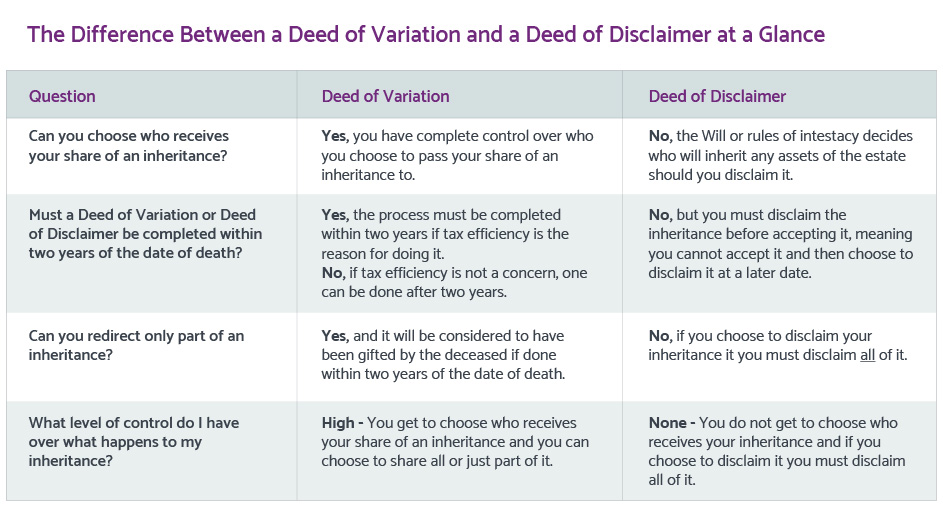
There are some key differences between a Deed of Variation and a Deed of Disclaimer which are important to be aware of. The table below summarises the key differences and will help you identify the right solution for you and your situation. If you need further help understanding the difference and deciding which is the right option for you, you can call us on 01924 290 029 or contact us using our online enquiry form.
Contact our specialist Deed of Variation Solicitors today for Advice
At Thornton Jones Solicitors, our experienced private client team can guide you through every step of putting a Deed of Variation or Deed of Disclaimer in place by:
- Explaining the key differences between a Deed of Variation and a Deed of Disclaimer, and which option best suits your circumstances
- Advising on the legal and tax implications, including Inheritance Tax (IHT) and Capital Gains Tax (CGT) considerations
- Helping you understand your rights as a beneficiary and the level of control each option provides
- Preparing the legal documentation accurately and in compliance with all formal requirements
- Ensuring any Deed of Variation is completed within the relevant two-year timeframe for tax purposes
- Liaising with personal representatives and other beneficiaries where required
Deciding what to do with an inheritance is an important financial and personal decision. Whether you wish to redirect your entitlement or formally refuse it, obtaining the right legal advice ensures your interests are protected and the process is handled correctly.
Get in touch with our friendly and knowledgeable team today to discuss your options. You can call us on 01924 290 029 or contact us using our online enquiry form.
Deed of Variation and Deed of Disclaimer FAQs
While a solicitor is not legally required for either document, professional advice is strongly recommended. A Deed of Variation must contain specific tax statements and meet formal requirements to be valid, and both documents may have long-term financial consequences.
Yes. A Deed of Variation can be completed before or after a Grant of Probate or Letters of Administration, as long as it is within two years of the date of death for tax purposes.
No. A Disclaimer is a complete refusal of the gift, and you cannot control who receives it next. The estate is distributed according to the Will or Intestacy Rules as if you had died before the deceased.
Generally, no. Once a Disclaimer is validly made, especially once the personal representative(s) act on it, it is effectively final. Beneficiaries should seek advice before signing because Disclaimers cannot simply be revoked.
Yes. When completed within two years of death and containing the correct tax statements, a Variation can allow assets to be redirected in a more tax‑efficient way. This can help reduce Inheritance Tax or Capital Gains Tax exposure in some circumstances.
Yes. A Deed of Variation can involve multiple beneficiaries if more than one person wishes to redirect their inheritance. Each person only affects their own share, unless the changes impact others who must then consent.
A Disclaimer applies to the entire gift, whether assets or debts or liabilities are attached. If the inheritance involves responsibility you do not wish to take on, a Disclaimer may be appropriate, but take legal advice, as it may have unintended legal consequences.




The content of this blog post is for information only and does not constitute formal legal advice and should not be relied upon as advice. Thornton Jones Solicitors Limited accepts no liability for any such reliance upon this content. Where the post includes links to external websites, Thornton Jones Solicitors Limited accepts no responsibility for the content of such sites. Any link to a third-party website should not be construed as endorsement by Thornton Jones Solicitors Limited of any content, products or services which are outside our direct control.
Deed of Variation Solicitors
NS&I Bereavement Claims Error – Where has it all gone wrong?
NS&I is one of the largest savings organisations within the UK, and therefore the recent headlines of “missing savings” and “prizes withheld” are alarming for everyone, not least the bereaved families whose loved ones held accounts with government-backed NS&I.

What is NS&I?
Originally established as the Post Office Savings Bank, National Savings & Investments (NS&I) is a government-owned savings provider in the UK, best known for its Premium Bonds product. Rather than paying interest, Premium Bonds offer entry into monthly prize draws, with two £1 million prizes and a range of smaller awards.
What other types of savings products do NS&I offer?
NS&I also offers other savings products, including ISAs and Income Bonds, the latter providing monthly interest payments. All funds held with NS&I are backed by HM Treasury, meaning savers benefit from a government guarantee, offering greater protection than that typically available through banks and building societies.
With no high street branches, NS&I are only contactable remotely. Money earned from NS&I customers and through its savings accounts and bonds offerings are used to fund public spending, and all deposits are backed by the UK Government with no upper limit, unlike the FSCS offered by the majority of high street banks.
How Does an NS&I Bereavement Claim Work?
When someone dies, their executors (if there is a Will) or personal representatives (if there is not) are responsible for notifying NS&I of the death, usually by providing a death certificate and relevant estate details.
Once notified, NS&I will carry out checks to identify any accounts or investments held by the deceased, including Premium Bonds, savings certificates, ISAs and Income Bonds. This step is intended to ensure that all holdings are correctly located, even where accounts may have been opened many years earlier.
NS&I will then provide instructions on how the accounts can be closed and the funds released. This typically involves completing bereavement claim forms and supplying evidence of authority to act on behalf of the estate.
Is Probate always required?
Whether probate is required will depend on the value of the NS&I holdings and the wider estate. Smaller balances may be released without probate, whereas larger estates will usually require a grant of probate (or letters of administration) before funds can be encashed and distributed to beneficiaries.
An executor is the person (or people) appointed in a Will to deal with the administration of the deceased’s estate after their death. Their role is to ensure that the deceased’s wishes, as set out in the Will, are carried out properly.
This typically includes identifying and collecting assets, settling any debts and liabilities, dealing with tax affairs, and distributing the remaining estate to the beneficiaries named in the Will. Executors may also be required to apply for a grant of probate, which provides them with the legal authority to deal with certain assets, such as bank accounts or investments.
Executors carry significant legal responsibility and must act in the best interests of the estate and its beneficiaries throughout the administration process.
Personal representatives is the legal term used to describe the individuals responsible for administering a deceased person’s estate. This includes executors where there is a valid Will, or administrators where there is no Will (intestacy).
In practical terms, personal representatives carry out the same core duties: identifying and valuing the estate, collecting assets, paying any debts and taxes, and distributing the estate to the rightful beneficiaries. Where a Will exists, the named executors automatically become the personal representatives once probate is granted.
They are legally responsible for ensuring the estate is administered correctly and in accordance with either the Will or the rules of intestacy, depending on the circumstances.
What Has Gone Wrong with NS&I Bereavement Claims?
It has recently been revealed in the news that up to 37,500 bereavement claims have been affected due to NS&I having lost track of investments and withholding premium bond prizes from the families of their deceased customers. That said, work to identify the affected parties is still underway so the true scale of the tracing issue isn’t certain.
Despite this issue only recently making the headlines in March 2026, it has been reported that the problem was initially reported to Government ministers in December 2025.
NS&I have explained that there had been errors in identifying all deceased account holders NS&I accounts, which in turn meant that executors and personal representatives were not always repaid money from all of the deceased’s accounts despite lodging bereavement claims in the correct manner.
What Is Probate?
The word probate is used to describe the process involved in dealing with the administration of a person’s estate when they have died. Probate can also be used to describe the legal document giving authority to the person or persons to administer the deceased’s estate. Read more…
What is NS&I’s Response to Missing Savings and Withheld Premium Bond Prizes?
NS&I have now advised that the identification issue has been resolved and that stringent measures have been put in place to ensure that no such issues happen again. Although this is little comfort for those battling to get their money back.
NS&I have confirmed that most cases affected relate to bereavements from 2008 – 2025, and it is estimated that the money owed from NS&I to the affected deceased estates could be up to £476 million. NS&I have been criticised by the financial ombudsman for repeatedly stating that its figures were accurate and correct, with this insistence only serving to prolong the investigation.
To date, NS&I have hired new staff to assist with making contact with the affected families and they will publish details of how they will reimburse the “missing” funds. As NS&I is government backed, the funds are protected, however it is likely to take some time for NS&I to reconcile the funds with the correct people.
What are the Tax Implications and What Should Affected Families Should Consider?
Where missing NS&I funds are later identified and returned to an estate, this can have knock-on tax consequences that executors and personal representatives will need to consider. Although the recovery of assets is beneficial, it may increase the overall value of the estate and affect its tax position retrospectively.
In particular, inheritance tax (IHT) may need to be reassessed if the additional funds change the estate’s total value. This could result in further tax becoming payable or require amendments to previously submitted IHT accounts to HMRC.
There may also be capital gains tax (CGT) considerations depending on how the estate has been administered, particularly where assets have been sold or invested during the administration period. In addition, any interest or compensation paid alongside the returned funds may itself have tax implications.
Given the complexity, executors may wish to seek professional advice to ensure the estate is correctly reported and any tax liabilities are properly addressed.
"*" indicates required fields
Do You Need to Take Action on an NS&I Bereavement Claim?
NS&I has confirmed that it is working to identify and contact affected estates in relation to the bereavement claims issue and any missing or unallocated savings. Where an estate is impacted, NS&I will contact executors or personal representatives directly with details of any funds due and how these will be returned.
NS&I has also advised that it is not necessary to use claims management companies, as this is unlikely to speed up the process and may result in avoidable costs.
However, executors should still ensure that all NS&I assets have been properly included in the estate administration. Where there is uncertainty or concern about missing funds, legal advice may be helpful to ensure the estate is fully and correctly administered.
Contact our Wills & Probate Solicitors today for Advice
At Thornton Jones Solicitors, our specialist Private Client and Wills & Probate team advises individuals, executors and families dealing with estate administration issues, including complex bereavement claims involving financial institutions such as NS&I.
We can assist you by:
- Advising on your duties as an executor or personal representative
- Helping you trace and identify missing assets within an estate, including NS&I savings and Premium Bonds
- Guiding you through the probate process where required
- Assisting with correspondence and claims to financial institutions
- Advising on delays, discrepancies, or missing funds in estate administration
- Supporting you with any tax considerations arising from delayed or additional estate assets
Dealing with an estate can be complex, particularly where assets are missing, delayed or incorrectly recorded. If you are concerned about NS&I bereavement claims or believe an estate may be owed funds, our team can provide clear, practical legal advice tailored to your circumstances.
To speak to our friendly Wills & Probate team, please call 01924 290 029 or contact us using our online enquiry form.
Wills and Probate Solicitors FAQs
If you believe funds may be missing, you should first ensure that a bereavement claim has been properly submitted to NS&I. If this has already been done, it is advisable to wait for NS&I to contact you, as they have confirmed they are proactively identifying affected cases.
If you remain concerned, executors or personal representatives can contact NS&I directly to request a review of the deceased’s accounts and confirm whether all funds have been accounted for.
NS&I offers a tracing service as part of its bereavement process. Executors or personal representatives can submit details of the deceased, and NS&I will attempt to locate any accounts or investments held in their name.
This is particularly important where paperwork is incomplete or where the deceased held Premium Bonds or older savings products.
Not always. Whether a grant of probate is required depends on the value of the assets held with NS&I. For lower-value holdings, NS&I may release funds without a grant. However, for larger estates, probate is usually required before funds can be encashed and distributed.
NS&I has stated that it is working to identify affected customers and will contact families directly where issues are found. However, given the scale of the problem and the time period involved, executors may wish to be proactive if they suspect something has been missed.
In addition to the return of any missing funds, affected estates may be entitled to interest and, in some cases, compensation. The exact amount will depend on the circumstances, including how long the funds were outstanding and whether there has been any financial loss as a result of the delay.
Yes. Premium Bonds remain eligible for prize draws for a period after death (usually up to 12 months), provided the funds have not yet been encashed. Any prizes won during this time should form part of the deceased’s estate and be payable to the beneficiaries.
Potentially, yes. If additional funds are later identified and returned to the estate, this could impact the overall value of the estate for inheritance tax purposes. This may require the personal representatives to revisit earlier tax calculations and, in some cases, submit corrective information to HMRC.
Not necessarily. NS&I has indicated that families do not need to use claims management companies, and many straightforward cases can be handled by executors directly. However, legal advice may be helpful where there are complications—such as missing funds, tax implications, or disputes between beneficiaries.
There is no fixed timeframe. Given the number of potentially affected cases, it may take some time for NS&I to investigate and reconcile all accounts. Executors should be prepared for delays, particularly in more complex cases or where older accounts are involved.
The content of this blog post is for information only and does not constitute formal legal advice and should not be relied upon as advice. Thornton Jones Solicitors Limited accepts no liability for any such reliance upon this content. Where the post includes links to external websites, Thornton Jones Solicitors Limited accepts no responsibility for the content of such sites. Any link to a third-party website should not be construed as endorsement by Thornton Jones Solicitors Limited of any content, products or services which are outside our direct control.
Wills & Probate Solicitors
Sean Hughes Death: The Dangers of a Homemade Will
The well loved Irish comedian Sean Hughes sadly passed away in 2017, leaving behind an estate of approximately £4 million. This included his main residence, estimated to be worth £1.8 million and two additional properties together estimated to be valued at £2.15 million.

The Problems With a Homemade Will
Sean’s Will was home-made, and it left “my three houses to Shelter” but at the time of his death only one of the three properties was owned in Sean’s personal name. The other two properties were owned by a company of which Sean was the sole shareholder.
Sadly, Sean’s estate is an example of some of the problems that preparing a home-made Will can lead to.
Sean’s estate had to be referred to the Court for a decision on how the estate should pass. Only now, almost 10 years after Sean’s death, has the dispute been concluded.
Why a Home-Made Will Can Be Invalidated Simply Due to the Choice of Wording
The issue with Sean’s choice of wording for the gift of the three houses to Shelter, is that strictly speaking only the one owned in Sean’s personal name was covered by this wording. The two properties owned by the company would fall into the residue of Sean’s estate, as technically they were not “his” houses, they were assets of the company.
The issue for the Court to consider, was whether the company shares (and therefore the properties owned by the company) should pass to Shelter along with the other property which was held in Sean’s personal name.

Fast, Free and Risky: Why You Shouldn’t Use AI to Write Your Will
Artificial intelligence is becoming part of everyday life. From drafting emails to answering questions and generating documents, it can feel quick, convenient and cost-effective. It’s therefore no surprise that some people are considering using AI tools to prepare their Will. Read more…
Sean Hughes left Three Properties to Shelter in his Homemade Will
Sean had been a long term supporter of the charity Shelter, and his family wished that all three properties should pass to Shelter.
The Court agreed that it was Sean’s intention that all three properties were to pass to Shelter and therefore this is what was ordered.
Sean’s family described him as a “great and generous comedian” who was “horrible at admin.” They went on to state that “we hope that Sean’s legacy will encourage others to think of people less privileged when making their final plans (ideally with at least a little bit of legal advice!)”.
What Are the Risks of Making a Homemade Will?
Sean’s case took almost 10 years and significant expense to be concluded, however these cases are becoming more common with the progression of technology and AI making it feel easier than ever to prepare your own Will.
Some of the common problems with homemade/AI made Wills are:
- Partial intestacy, where gifts fail or do not cover all the assets that the testator intended to be covered due to poor or ambiguous wording.
- Complexities of business assets etc not being fully understood and therefore not correctly provided for in the Will.
- Misunderstandings around how different jointly owned assets will pass upon death and when additional steps need to be taken to ensure that joint assets pass how the testator wishes.
- AI cannot accurately assess a person’s capacity or their mental state when they are making their Will, leaving home made Wills more open to challenge than solicitor prepared Wills where stringent records are kept regarding the making of the Will.
"*" indicates required fields
Contact our Wills & Probate Solicitors for Advice
At Thornton Jones we can assist you to prepare a legally valid Will to ensure that your estate passes to those that you wish to benefit. If you would like to make an appointment to discuss this further, please call one of our offices to arrange an initial consultation.
If you need assistance or advice you can contact our team today on 01924 290 029 or contact us using our online enquiry form.
Wills & Probate FAQs
Homemade wills can lead to serious legal issues, including unclear wording, missed assets and partial intestacy. As seen in Sean Hughes’ case, this can result in lengthy court proceedings, delays in distributing the estate and significant legal costs. Thornton Jones say that even well-meaning DIY wills can cause long-term complications. A professionally drafted will ensures your estate is protected and your wishes are clearly followed.
Yes, a will can be challenged if its wording is ambiguous or does not clearly reflect the person’s intentions. Courts may need to interpret the will, which can be time-consuming and expensive, potentially delaying the distribution of the estate. At Thornton Jones Solicitors we often see wills delayed or disputed because key details were overlooked. Seeking professional guidance from an experience and qualified solicitor can prevent unnecessary stress for your loved ones.
A solicitor ensures your will is legally valid, clearly drafted and covers all of your assets, including complex arrangements like business ownership. They also assess capacity and keep detailed records, helping to reduce the risk of disputes or challenges after death. At Thornton Jones, we make sure every will is tailored to the client’s circumstances, providing clarity, security and peace of mind.
The content of this blog post is for information only and does not constitute formal legal advice and should not be relied upon as advice. Thornton Jones Solicitors Limited accepts no liability for any such reliance upon this content. Where the post includes links to external websites, Thornton Jones Solicitors Limited accepts no responsibility for the content of such sites. Any link to a third-party website should not be construed as endorsement by Thornton Jones Solicitors Limited of any content, products or services which are outside our direct control.
Wills & Probate Solicitors
What Are Statutory Trusts That Arise on Intestacy?

When someone dies without a valid Will, they are said to have died intestate. In England and Wales, their estate is then distributed under the rules of intestacy, set out in legislation. In many cases, those rules create what are known as statutory trusts.

What is a Statutory Trust?
A statutory trust is a trust that arises automatically by law, rather than being deliberately created by a Will.
Under the intestacy rules, certain beneficiaries (most commonly children) do not receive their inheritance outright immediately. Instead, their entitlement is held on trust until specific conditions are met.
When Do Statutory Trusts Arise?
Statutory trusts commonly arise where the deceased is survived by:
- children, or
- other close family members who are entitled under the intestacy rules
The most common example is where a person dies leaving children under the age of 18.
Who Benefits Under a Statutory Trust?
Under the rules of intestacy, beneficiaries typically include:
- children (including legally adopted children), and
- their descendants if a child has already died
Each beneficiary is entitled to a share of the estate, but that share is held on statutory trust until they are legally entitled to receive it outright.

What are the Rules of Intestacy?
The Rules of Intestacy can be quite complex to understand, particularly if there are a significant number of beneficiaries. If you are married and have children, only the first £322,000 will pass to your surviving spouse, the remainder will be divided between your children and your spouse. Read more…
When Does a Beneficiary of a Statutory Trust Become Entitled?
Under a statutory trust, a beneficiary becomes absolutely entitled when they:
- reach 18 years of age, until then, their inheritance is held and managed by trustees.
Who Acts as Trustee of a Statutory Trust?
The personal representatives (usually the administrators of the estate) act as trustees of the statutory trust. They are responsible for:
- safeguarding the assets
- managing investments
- applying income or capital for the beneficiary’s benefit where appropriate
This role carries legal duties and responsibilities.
What Can the Trustees of a Statutory Trust Do With the Funds?
Trustees have limited statutory powers, including the ability to:
- use income or capital for a child’s maintenance, education or benefit, and
- invest the funds until the beneficiary becomes entitled
However, the flexibility is far more restricted than if a tailored trust had been created by a Will.
"*" indicates required fields
Why Can Statutory Trusts Be Problematic?
Statutory trusts are one-size-fits-all and may not reflect what the deceased would have wanted. Common issues include:
- beneficiaries inheriting outright at 18, regardless of maturity
- no scope to protect assets from divorce, creditors or poor decision-making
- no ability to benefit stepchildren or unmarried partners
- increased administrative burden for trustees
How Can You Avoid a Statutory Trust Being Invoked?
The only way to avoid statutory trusts arising on death is to have a properly drafted Will. A Will allows you to:
- choose who inherits
- decide when and how beneficiaries receive their inheritance
- appoint trustees of your choosing
- include flexible trust arrangements where appropriate
Contact our Wills & Probate Solicitors for Advice
Understanding statutory trusts highlights why estate planning is so important and why dying without a Will can leave loved ones with outcomes you never intended.
At Thornton Jones Solicitors our private client team can assist you in preparing a Will that reflects your wishes and will avoid unintended consequences. Contact our friendly and professional team today for more information.
If you need assistance or advice you can contact our team today on 01924 290 029 or contact us using our online enquiry form.
Statutory Trust FAQs
A statutory trust arises automatically under the rules of intestacy when someone dies without a valid Will. In contrast, a trust created by a Will is deliberately set up by the person who has died, allowing them to control how and when beneficiaries receive their inheritance.
Under a statutory trust, children usually become entitled to their inheritance when they reach 18. Until then, their share of the estate is held and managed by trustees on their behalf.
Statutory trusts are automatically created by law under the rules of intestacy, most commonly to manage the inheritance of minors. While you cannot remove the legal effect once the trust arises, there are ways to manage or conclude it. For example, the trust automatically ends when a beneficiary reaches 18, giving them full entitlement to their share. Trustees may also, in certain cases, convert the statutory trust into a bare trust to give the beneficiary more control over the assets.
The most effective way to avoid a statutory trust entirely is to make a valid Will. By doing so, you can specify who inherits, when they inherit, and under what conditions, ensuring your estate is distributed according to your wishes rather than default intestacy rules. Proper estate planning also reduces administrative burdens and helps protect assets from unintended risks.
The content of this blog post is for information only and does not constitute formal legal advice and should not be relied upon as advice. Thornton Jones Solicitors Limited accepts no liability for any such reliance upon this content. Where the post includes links to external websites, Thornton Jones Solicitors Limited accepts no responsibility for the content of such sites. Any link to a third-party website should not be construed as endorsement by Thornton Jones Solicitors Limited of any content, products or services which are outside our direct control.
Wills & Probate Solicitors
Who can be my Executor? Professional Executors vs. Lay Executors

When providing instructions for a Will, the Testator will be asked to name an Executor within the terms of the Will. At the very least, they will be asked to appoint one Executor and at the most they can appoint four Executors.

What is an Executor to a Will?
An Executor to a Will is someone who will be responsible upon the Testator’s death to manage the deceased’s estate. It is their duty to ensure that the following are completed:
- The deceased’s wishes are carried out;
- All assets have been identified and disposed of in accordance with the Will;
- All liabilities including debts, taxes and testamentary expenses have been settled; and
- A Grant of Probate has been obtained, if required.
The role is not restricted to the above points; however, these obligations will take up most of the Executor’s time and focus.
Who can be an Executor of a Will?
In England and Wales, anyone is eligible to be appointed as an Executor as long as they are over the age of 18 and have mental capacity to undertake and perform the duties of an Executor.
Usually, people appoint their close family members or close friends as Executors. For example, their spouse, children, parents, siblings, lifelong friends etc. These kinds of Executors are known as Lay Executors.
However, professionals can also be appointed as Executors too, i.e. solicitors. These are referred to as Professional Executors. Professional Executors can be appointed when there is no-one you feel is willing or suitable to take this role on but also for a number of other reasons too.
Can a Beneficiary of a Will also be the Executor?
An Executor can also be a beneficiary under the terms of the Will. For example, if you appoint your spouse as an Executor and everything is to pass to them upon your death, this will not prevent them from acting as an Executor.
It is entirely up to the Testator who they wish to pick to be their Executor. When considering this decision, they may contemplate what is best suited to their specific circumstances and how they wish for their estate to be dealt with upon their death. It is important to note that Executors can be changed by updating your Will and it is not a definitive decision.
What are the Rules of Intestacy?
The Rules of Intestacy can be quite complex to understand, particularly if there are a significant number of beneficiaries. If you are married and have children, only the first £322,000 will pass to your surviving spouse, the remainder will be divided between your children and your spouse. Read more…
What are the benefits of appointing a Lay Executor?
1. Trust and Personal Knowledge
When appointing a Lay Executor, this is likely to be someone close to you and who knows you on a personal level. Therefore, when dealing with the estate administration they are likely to make decisions in consideration of your personal wishes. For example, if they were planning your funeral, it is likely that they would take a personable approach by considering your wishes, such as having consideration to religious beliefs, music choices and desires regarding burial or cremation.
Another example where a personal approach may be taken is in regard to the distribution of personal items, i.e., jewellery, they may have knowledge that something is a family heirloom so you may wish for this to be passed on to a family member rather than this being discarded.
Having an Executor act who has known you and has prior knowledge of your circumstances can be a useful when dealing with the Estate. This can help the Executor navigate the administrative process with care and respect to your personal wishes. It is also advantageous when dealing with family of the deceased and handling their dynamics. They may understand certain situations need to be handled carefully and proceed to deal with sensitive situations with compassion.
Appointing a family member or friend to be an Executor may give the deceased peace of mind due to the implicit trust and faith they have in the individual to deal with matters how they would like.
2. Saving on Legal Costs
Appointing a family member or friend to be the Executor to deal with the estate administration can save on legal costs. They have no rights to charge for this service and cannot profit from undertaking the role.
It is the Executor’s discretion if they seek legal advice and instruct solicitors to help them with the administrative process. If they choose not to, the estate will not bear a burden of settling legal costs unlike if a Professional Trustee was acting.
However, Executors are entitled to claim back their expenses from the estate funds. For example, payment of death certificates, the probate application fee, administrative costs etc but they cannot charge for their time and dedication to the role.
3. Flexibility and Informality
Choosing a Lay Executor may be mean that the estate is dealt with on a more informal basis. For example, communications with beneficiaries may be more causal. Lay Executors may explain the processes in plain language and remove the legal jargon which can arise when solicitors are dealing with an estate.
In addition, a Lay Executor may have increased understanding towards the deceased’s family dynamics. They may have the potential to foresee anticipated disputes, and this can be helpful when managing the expectations of those involved, minimising tensions and resolving conflict. They are likely to understand any emotional ties to personal and sentimental items and consider who may wish to retain such items within the family.
Flexibility and informality can mean that there is more natural communication between the Executor and beneficiaries, and the Lay Executor could use their emotional awareness to manage the family’s needs and expectations by making relationship-sensitive decisions. However, the informal and flexible approach should not compromise them in their role to comply with the legal framework of the estate administration.
In summary, Lay Executors can bring a more personal approach to the estate administration and at a lower cost than a Professional Executor.
"*" indicates required fields
What are the benefits of appointing a Professional Executor?
1. Legal Expertise and Taxation Knowledge
Estate administration can involve many complex tasks, for example: –
- Completion of a probate application;
- Inheritance Tax calculations;
- Payments of Income Tax, Capital Gains Tax and Inheritance Tax;
- Property transfers and sales;
- Business and share valuations; and
- Dealing with creditors
The list is not exhaustive, however many of the tasks can be hard to navigate with no legal training or background. A legal professional will be highly skilled and has been legal trained, therefore if acting as a Professional Executor they can understand and apply their knowledge regarding estate administration and taxation laws to those specific circumstances; understand compliance and rules relating to reporting such information and the deadlines they carry, which can reduce the risks of making costly mistakes.
Due to little understanding, Lay Executors can make small errors which can be hard to fix, by simply not having the deeper knowledge to assist them in the estate administration. Professional Executors have expert knowledge, and they are trained to avoid making such mistakes.
2. Complex and High Value Estates
The higher the value of the Estate, the more technical the Estate becomes to administer. Estates which include multiple properties, assets overseas, trusts, agricultural and business assets and large investments bring their own technical complexities. Taxation reliefs become more important to consider, and Inheritance Tax liabilities are more likely to arise. These kinds of estates can be overwhelming for a Lay Executor to navigate and understand. Therefore, a Professional Executor will have more experience on how to handle high-net worth estates and can apply their knowledge to tax-planning and complex points of law.
3. Managing Family Disputes
Often people opt to appoint Professional Executors to act when there are ongoing family tensions or history of family disputes, as they can offer an impartial and unbiased approach to the estate administration.
Tensions can arise between families at any point, i.e., during the Testators lifetime or upon death and these can impact the administration of the Estate. For example, when relatives have been treated unequally in the Will, ex-partners or blended families have grievances against the terms of the Will and dependants may wish to challenge the Will. This can develop into litigious proceedings and be difficult for Lay Executors to deal with.
If this is likely to happen, a Professional Executor may be more advantageous to have appointed as they can act independent to the ongoing conflict. Professionals have no emotional involvement, and they are obligated to distribute the Estate strictly in line with the Will. Professional Executors will take an unbiased approach to such circumstances, and this can help protect the estate from litigious proceedings.
4. Protecting Family Members from Stress
Loosing someone close to you then having to act as a Lay Executor can be an emotional challenge. Dealing with grief and a loved one’s Estate can cause great stress and anxiety.
The process of dealing with estate administration is burdensome on a Lay Executor, as it is time-consuming, administrative and often overwhelming. It can involve a volume of paperwork, handling distressed beneficiaries, managing property sales and sorting through personal belongings which can be hard when navigating grief.
Appointing a Professional Executor can remove the emotional ties and protect family members from the extra burden of dealing with a loved one’s Estate. They will have the time to grieve without the administrative pressure and the freedom to process their emotions without having to deal with lengthy legal matters.
5. Continuity and Reliability
Appointing a Professional Executor can ensure some structure and consistency when dealing with the estate administration. As they are acting in their professional capacity, they must remain impartial and unbiased in order to uphold their profession’s code of conduct, meaning that can be trusted and deal with the Estate in an ethical and efficient manner.
They also have internal systems and procedures, meaning that every decision or step taken in relation to progressing the matter will be documented and recorded to ensure a smooth and fluid transition through the administrative process. Internal procedures ensures that work can be delegated to other members of the team so work can be actioned in a timely and smooth manner.
It is unlikely that a solicitor will die or become incapacitated during the administration period, unlike the appointment of an elderly relative such as a sibling or parent. If a solicitor does become unable to act, it will become less problematic than if this were to happen to a Lay Executor. Another member of the Firm would likely step in to replace the Professional Executor.
Having a Professional Executor making decisions in regard to the Estate can ensure that it is dealt with in an efficient and reliable manner.
6. Reduce Personal Liability Risk
Executors can become personally liable if they distribute assets before settling debts, miscalculate tax owed from the estate, fail to identify claims against the estate or breach fiduciary duties. This means that they can find themselves in a position whereby they are owing monies to creditors and beneficiaries from their personal finances, through innocent and small errors.
Appointing a Professional Executor would ensure that a Lay Executor does not become liable in these circumstances. Professional Executors have a thorough understanding of mitigating risks and following formal procedures. They understand how to protect themselves in this instance by keeping detailed accounts and contacting and notifying creditors to ensure all debts are settled. They have access to conducting financial searches to identify any liabilities and are able to publish specialised notices to creditors. This protects family members and friends from compromising themselves financially through minor and naïve errors.
Overall, Professional Executors can take an unbiased approach and take on the majority of the administrative and time-burdensome work. They can apply their legal expertise to decisions made in relation to the Estate in order to mitigate risks and errors which can cause personal liability to arise.
Conclusion
In conclusion, there is no right or wrong answer as to who an Executor can be. Both Lay Executors and Professional Executors have their own advantages but there is not a one size fits all answer.
When choosing an Executor to appoint, it is advisable to consider the bigger picture and your personal circumstances, by making a balanced and informed choice what you as a Testator will be comfortable with upon death.
How can Thornton Jones help?
Here at Thornton Jones, we can offer bespoke advice regarding the role of Executors. We can assist you in deciding who to choose to be an Executor in your Will by providing you with detailed information relating to the appointment of Lay Executors and Professional Executors and updating your Will in this regard.
In most circumstances, the Directors of Thorntons Jones are willing to be appointed as Professional Executors and we can explain how this would work in terms of your Estate, such as how we can offer a personal element, who would handle the estate day to day and any fees which this may incur.
Our experienced team can also assist any Lay Executors who may be struggling with the estate administration and need some extra support and advice in this regard. If appropriate, they assist with more limited work such as applying for probate or offering bespoke and specific advice in relation to your role as a Lay Executor. They can also assist with dealing with high value and complex estates and can take on the full estate administration and reduce the burden of this upon the individual where appropriate.
Contact our Wills & Probate Solicitors for Advice
Choosing the right Executors and preparing a clear Will are key steps to ensure your estate is managed according to your wishes. Without a Will, statutory trusts may determine who inherits, potentially creating outcomes you did not intend and leaving loved ones in a difficult position.
At Thornton Jones Solicitors, our Private Client team can guide you through appointing Executors you trust and drafting a Will that reflects your intentions. We help you plan ahead so your estate is handled smoothly and in line with your wishes.
For personalised advice or assistance, contact our team today on 01924 290 029 or via our online enquiry form. We’re here to help you make the right choices for your estate and your loved ones.
Executor of a Will FAQs
The key distinction lies in their roles within the context of a Will. The testator is the individual who creates the Will, setting out their wishes regarding how their estate should be managed and distributed after their death. As part of this process, the testator may specify that certain assets, or a portion of their estate, are to be placed into a trust for the benefit of particular individuals.
The executor, on the other hand, is the person appointed in the Will to carry out those wishes. Their responsibilities include collecting and valuing the estate, settling any outstanding debts, taxes, and administrative expenses, and ensuring that any specific gifts are distributed correctly and in accordance with the wishes of the Testator.
You can appoint up to four executors to your Will in the UK, although only one is strictly required. It is common and recommended to appoint at least two Executors to share the workload, provide backup if one is unable to act, and ensure security. All appointed executors must act jointly.
A lay executor (usually family/friends) acts unpaid, offering a personal, cost-effective service, whereas a professional executor (e.g., solicitor) charges fees for expert, impartial, and insured estate administration. Lay executors are suitable for simple estates, while professionals reduce risk in complex scenarios involving tax, trusts, or potential disputes.
The content of this blog post is for information only and does not constitute formal legal advice and should not be relied upon as advice. Thornton Jones Solicitors Limited accepts no liability for any such reliance upon this content. Where the post includes links to external websites, Thornton Jones Solicitors Limited accepts no responsibility for the content of such sites. Any link to a third-party website should not be construed as endorsement by Thornton Jones Solicitors Limited of any content, products or services which are outside our direct control.
Contact our Wills & Probate Solicitors in Garforth, Leeds
Thornton Jones Solicitors
Westbourne House
99 Lidgett Lane
Garforth
Leeds
LS25 1LJ
Tel: 0113 246 4423
Fax: 0113 831 4929
Email: enquiries@thorntonjones.co.uk
Contact our Wills & Probate Solicitors in Wakefield
Thornton Jones Solicitors
Bank House
1 Burton Street
Wakefield
WF1 2GF
Tel: 01924 290029
Fax: 01924 290240
Email: enquiries@thorntonjones.co.uk
Contact our Wills & Probate Solicitors in Ossett, Wakefield
Thornton Jones Solicitors
25 Bank Street
Ossett
WF5 8PS
Tel: 01924 586466
Fax: 01924 290240
Email: enquiries@thorntonjones.co.uk
Contact our Wills & Probate Solicitors in Sherburn in Elmet, Leeds
Thornton Jones Solicitors
6 Finkle Hill
Sherburn in Elmet
Leeds
LS25 6EA
Tel: 01977 350500
Fax: 0113 831 4929
Email: enquiries@thorntonjones.co.uk
Fast, Free and Risky: Why You Shouldn’t Use AI to Write Your Will
Artificial intelligence is becoming part of everyday life. From drafting emails to answering questions and generating documents, it can feel quick, convenient and cost-effective. It’s therefore no surprise that some people are considering using AI tools to prepare their Will.
Is It Safe to Use AI to Write My Will?
Whilst AI can be a helpful starting point for understanding many legal concepts, it is far from a suitable substitute for expert and tailored legal advice from a trained legal professional, particularly when it comes to something as important as drafting your Will.
A Will Is Not a Standard Document
No two clients are the same. All individuals have different family structures and dynamics, different assets, business interests, tax positions and personal wishes and all of these things impact how a Will should be drafted.
AI works by producing generic wording based on common patterns and probabilities. It cannot properly assess:
- blended families or second marriages
- vulnerable beneficiaries
- overseas assets
- business or agricultural property
- trusts, life interests or discretionary arrangements
A Will that looks fine on the surface may indeed be legally valid but wholly inappropriate for your specific personal circumstances which can lead to significant problems in the future.
AI Cannot Give Legal Advice or Spot Risks in Your Wishes
A solicitor’s role is not just to write down what you say, it is to listen, to ask the right questions, to flag potential problems with your wishes and to explain the consequences of the different choices you wish to make.
When making a Will AI cannot:
- advise on inheritance tax planning
- assess capacity or undue influence
- warn you about potential claims under the Inheritance (Provision for Family and Dependants) Act 1975
- ensure your wishes are clear enough to avoid disputes
These are often the very issues that lead to costly disputes and litigation after death.
"*" indicates required fields
Errors in your Will May Only Come to Light When It Is Too Late
One of the greatest risks with AI-generated Wills is that mistakes are often only discovered after death, when they cannot be corrected.
Common problems include:
- unclear or contradictory clauses
- gifts failing due to the incorrect wording being used
- executors lacking the necessary powers they require to assist in the administration
- invalid execution or witnessing of the Will
At that point, the cost of fixing the problem usually far exceeds the cost of having the Will professionally prepared by a Solicitor in the first place.
Capacity, Safeguarding and Record-Keeping Matter
Solicitors are trained to assess testamentary capacity and to identify red flags around vulnerability or pressure from others. We also keep detailed attendance notes and records that can be crucial if a Will is later challenged.
AI tools cannot:
- assess testamentary capacity
- protect against coercion
- provide evidence if the Will is disputed
These safeguards are a vital part of proper Will-making.

Do I need to register my Trust with HMRC?
Most trusts in the UK must be registered with HMRC’s Trust Registration Service, but certain trusts are exempt, such as those imposed by a court or created through legislation. Trustees are legally responsible for ensuring registration where required. Failing to do so can lead to penalties, so it is important to confirm your obligations with a solicitor or a tax adviser. Read more…
Convenience Should Not Outweigh Certainty
AI can be fast, but speed should not be the priority when dealing with your estate and your family and loved one’s future.
Using AI may feel efficient now, but it carries significant legal and financial risk later.
Contact our Wills and Probate Solicitors for Advice
At Thornton Jones Solicitors we use the appropriate technology in places where it enhances efficiency, but be assured that your Will is always prepared by an experienced solicitor who understands the law and, crucially, your individual circumstances.
At Thornton Jones our Private Client Solicitors will:
- take time to understand your wishes and you unique family situation
- advise on inheritance tax, trusts and future planning
- ensure your Will is clear, valid and robust
- provide advice to reduce the risk of disputes after death
Your Will is one of the most important documents you will ever sign. It deserves more than a generic template, it deserves proper legal advice.
Our experienced Wills and Probate team will are here to advise you when making your Will to ensure that the final document accurately reflects your wishes.
If you need assistance or advice you can contact our team today on 01924 290 029 or contact us using our online enquiry form.
Wills and Probate Solicitors FAQs
Testamentary capacity refers to a person’s legal ability to make or change a valid Will. Under English law, the person making the Will (known as the testator) must understand that they are making a Will, understand the nature and extent of their assets, and recognise who might reasonably expect to benefit from their estate. Wills can be challenged on the basis of a testator lacking testamentary capacity at the time the Will was prepared. A testator may lack testamentary capacity due to reasons of illness, cognitive impairment or vulnerability.
Coercion when making a Will occurs when someone may pressure, threaten or manipulate the person making the Will into including provisions they would not otherwise choose that may benefit them or another person. This pressure can take many forms, emotional, psychological or even physical. This type of behaviour is sometimes referred to as undue influence. If a court finds that the Will was made under undue influence, it can be declared invalid, because it does not reflect the true wishes of the testator.
The Inheritance (Provision for Family and Dependants) Act 1975 allows certain individuals to make a legal claim against a deceased person’s estate if they believe they have not been left reasonable financial provision. Eligible claimants may include spouses, civil partners, children, cohabiting partners, or dependants of the deceased. The court can redistribute part of the estate if it considers the Will or intestacy rules do not provide adequate financial support.
The content of this blog post is for information only and does not constitute formal legal advice and should not be relied upon as advice. Thornton Jones Solicitors Limited accepts no liability for any such reliance upon this content. Where the post includes links to external websites, Thornton Jones Solicitors Limited accepts no responsibility for the content of such sites. Any link to a third-party website should not be construed as endorsement by Thornton Jones Solicitors Limited of any content, products or services which are outside our direct control.
Contact our Wills and Probate Solicitors in Garforth, Leeds
Thornton Jones Solicitors
Westbourne House
99 Lidgett Lane
Garforth
Leeds
LS25 1LJ
Tel: 0113 246 4423
Fax: 0113 831 4929
Email: enquiries@thorntonjones.co.uk
Contact our Wills and Probate Solicitors in Wakefield
Thornton Jones Solicitors
Bank House
1 Burton Street
Wakefield
WF1 2GF
Tel: 01924 290029
Fax: 01924 290240
Email: enquiries@thorntonjones.co.uk
Contact our Wills and Probate Solicitors in Ossett, Wakefield
Thornton Jones Solicitors
25 Bank Street
Ossett
WF5 8PS
Tel: 01924 586466
Fax: 01924 290240
Email: enquiries@thorntonjones.co.uk
Contact our Wills and Probate Solicitors in Sherburn in Elmet, Leeds
Thornton Jones Solicitors
6 Finkle Hill
Sherburn in Elmet
Leeds
LS25 6EA
Tel: 01977 350500
Fax: 0113 831 4929
Email: enquiries@thorntonjones.co.uk