Deeds of Variation vs. Deeds of Disclaimer

A Simple Guide for Beneficiaries in England and Wales
When you inherit from someone’s estate, you may find that the original distribution does not reflect your personal wishes, family circumstances, or financial priorities. In England and Wales, beneficiaries can use two main tools to change what happens to their inheritance.

These two tools are known as a Deed of Variation and a Deed of Disclaimer. Although they may appear similar, they operate quite differently. In this guide we explain each option in straightforward language so that you can easily tell the difference between a Deed of Variation and a Deed of Disclaimer.
What Is a Deed of Variation?
A Deed of Variation allows a beneficiary of an estate to legally redirect all or part of their inheritance to someone else. The Will, or Intestacy Rules if there is no Will, remain unchanged, but the beneficiary alters how their personal share is distributed.
What are the Key Features of a Deed of Variation
- You may redirect all or part of your inheritance to any person or charity
- It must be completed within two years of the date of death for tax efficiency purposes
- Often used for Inheritance Tax (IHT) or Capital Gains Tax (CGT) planning
Common Reasons to Use a Deed of Variation
- To improve tax efficiency within the estate
- To support family members who were left out of the Will
- To correct imbalance or help maintain family harmony
- You want flexibility in how the estate is shared
- You want to reduce tax liability

"*" indicates required fields
What Is a Deed of Disclaimer?
A Deed of Disclaimer allows a beneficiary of an estate to refuse their inheritance entirely. Once you disclaim, you do not receive the asset or funds and cannot decide who gets the inheritance. Instead, the inheritance reverts back to the estate and is distributed under the Will or Intestacy Rules, if there is no Will.
What are the Key Features of a Deed of Disclaimer?
- You must disclaim before accepting the gift
- You must disclaim the whole gift, not part of it
- You have no control over the new recipient
Common Reasons to Use a Deed of Disclaimer
- Avoiding assets that may bring financial or tax complications
- Allowing the estate to pass according to an original Will without your involvement
- You are happy for the Will or Intestacy Rules to determine who benefits from the inheritance

Can I Vary a Will After Someone Has Died?
Yes, it is possible to vary a Will after someone has died, and there are legal provisions that allow for this. This process is typically done using a Deed of Variation, which gives beneficiaries the ability to alter how the estate is distributed, even after the death of the individual who made the Will. Read more…
What are the Key Differences Between a Deed of Variation and Deed of Disclaimer?
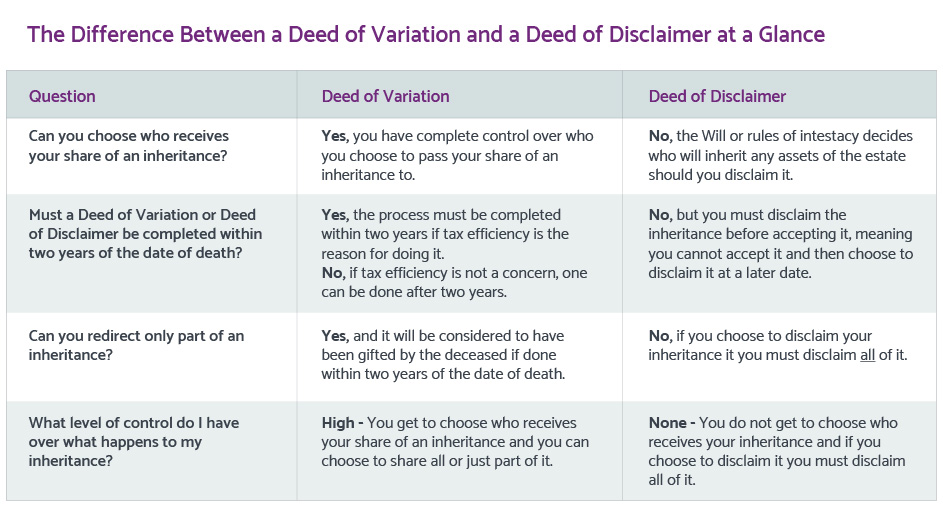
There are some key differences between a Deed of Variation and a Deed of Disclaimer which are important to be aware of. The table below summarises the key differences and will help you identify the right solution for you and your situation. If you need further help understanding the difference and deciding which is the right option for you, you can call us on 01924 290 029 or contact us using our online enquiry form.
Contact our specialist Deed of Variation Solicitors today for Advice
At Thornton Jones Solicitors, our experienced private client team can guide you through every step of putting a Deed of Variation or Deed of Disclaimer in place by:
- Explaining the key differences between a Deed of Variation and a Deed of Disclaimer, and which option best suits your circumstances
- Advising on the legal and tax implications, including Inheritance Tax (IHT) and Capital Gains Tax (CGT) considerations
- Helping you understand your rights as a beneficiary and the level of control each option provides
- Preparing the legal documentation accurately and in compliance with all formal requirements
- Ensuring any Deed of Variation is completed within the relevant two-year timeframe for tax purposes
- Liaising with personal representatives and other beneficiaries where required
Deciding what to do with an inheritance is an important financial and personal decision. Whether you wish to redirect your entitlement or formally refuse it, obtaining the right legal advice ensures your interests are protected and the process is handled correctly.
Get in touch with our friendly and knowledgeable team today to discuss your options. You can call us on 01924 290 029 or contact us using our online enquiry form.
Deed of Variation and Deed of Disclaimer FAQs
While a solicitor is not legally required for either document, professional advice is strongly recommended. A Deed of Variation must contain specific tax statements and meet formal requirements to be valid, and both documents may have long-term financial consequences.
Yes. A Deed of Variation can be completed before or after a Grant of Probate or Letters of Administration, as long as it is within two years of the date of death for tax purposes.
No. A Disclaimer is a complete refusal of the gift, and you cannot control who receives it next. The estate is distributed according to the Will or Intestacy Rules as if you had died before the deceased.
Generally, no. Once a Disclaimer is validly made, especially once the personal representative(s) act on it, it is effectively final. Beneficiaries should seek advice before signing because Disclaimers cannot simply be revoked.
Yes. When completed within two years of death and containing the correct tax statements, a Variation can allow assets to be redirected in a more tax‑efficient way. This can help reduce Inheritance Tax or Capital Gains Tax exposure in some circumstances.
Yes. A Deed of Variation can involve multiple beneficiaries if more than one person wishes to redirect their inheritance. Each person only affects their own share, unless the changes impact others who must then consent.
A Disclaimer applies to the entire gift, whether assets or debts or liabilities are attached. If the inheritance involves responsibility you do not wish to take on, a Disclaimer may be appropriate, but take legal advice, as it may have unintended legal consequences.




The content of this blog post is for information only and does not constitute formal legal advice and should not be relied upon as advice. Thornton Jones Solicitors Limited accepts no liability for any such reliance upon this content. Where the post includes links to external websites, Thornton Jones Solicitors Limited accepts no responsibility for the content of such sites. Any link to a third-party website should not be construed as endorsement by Thornton Jones Solicitors Limited of any content, products or services which are outside our direct control.