Conveyancing Timeframes: Why Some Transactions Take 8 Weeks and Others Take 20+

Buying or selling a home is exciting but waiting for completion can be stressful. One of the most common questions we hear is: “How long will my conveyancing take?” The answer depends on several factors.

Conveyancing Timeframes: Type of Property
The type of property you are buying can have a big impact on the conveyancing process. Different property types come with their own legal considerations and potential complications, which can affect how long your transaction takes. Knowing what to expect for freehold, leasehold, new-build, or older and unusual properties can help you plan ahead and avoid unnecessary delays.
- Freehold vs Leasehold: Leasehold properties often need extra checks, like service charges and management approvals, which can add time.
- New Builds: Developers’ legal packs can speed things up or cause delays if incomplete.
- Older or unusual properties: Listed buildings or shared-access plots may require additional enquiries.
Conveyancing Timeframes: Mortgage and Searches
Obtaining a mortgage and carrying out property searches are key parts of the conveyancing process, but they can also impact how quickly a transaction progresses. Lenders require valuations, approvals, and supporting documentation, while local authority searches typically take 2–6 weeks and environmental searches typically take a few days. If any issues are uncovered, your solicitor will need to raise enquiries with the seller, which can add further time to your purchase.
- Lenders need valuations, approvals, and documentation, which can slow progress.
- Local authority searches typically take 2–6 weeks, depending on the council.
- Environmental searches typically take just a few days.
- If issues arise during searches, your solicitor will raise enquiries with the seller, which can add time.
Conveyancing Timeframes: Chains and Client Responsiveness
The length of a property chain can significantly influence how quickly a transaction completes. Short chains tend to move smoothly, while longer chains involving multiple buyers and sellers are more prone to delays. Your own responsiveness—providing signatures, proof of funds, and requested documents promptly—can make a real difference in keeping the process on track.
- Short chains move quickly, while long chains (multiple buyers and sellers) are more prone to delays.
- Responding promptly to requests for signatures, proof of funds, or documents helps speed things up.

If you are buying a property then you can use our FREE ONLINE CONVEYANCING CALCULATOR to get an instant and no-obligation online conveyancing quote. If you’d prefer to speak with a person, simply call us at any of our offices to speak to our expert residential conveyancing solicitors.
Conveyancing Timeframes: Unexpected Issues
Even straightforward transactions can hit surprises, such as:
- Title discrepancies
- Boundary disputes
- Conditional planning or restrictive covenants
Each may require extra investigation or negotiation.
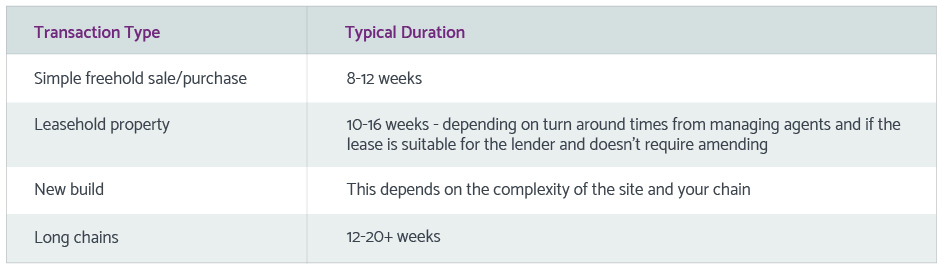
Typical Conveyancing Timeframes (guide only)
The table below outlines the typical conveyancing timeframes depending on the type of property transaction. A simple freehold sale or purchase usually takes between 8 and 12 weeks. Leasehold transactions tend to take longer, typically 10 to 16 weeks, as they often depend on managing agents’ turnaround times and whether the lease meets the lender’s requirements or needs to be amended.
New build purchases do not have a fixed timeframe, as the duration depends on the complexity of the development and the position of the property chain. Transactions involving long chains generally take the longest, often lasting 12 weeks or more, due to the additional coordination required between multiple parties.
How Thornton Jones Solicitors can Help with your Property Purchase
Our conveyancing team keeps you updated at every stage of the conveyancing process. We coordinate with mortgage lenders and other solicitors in the chain, and we proactively manages all enquiries to avoid unnecessary delays. Good communication is key to a smoother transaction.
Even though conveyancing times vary, understanding the factors at play can reduce stress and help you plan your move with confidence.
Whether you’re a first-time buyer or an experienced investor, we provide clear, proactive advice so you can move forward with confidence. Contact us today on 01924 290 029 or via our online enquiry form to speak with a solicitor who will handle your purchase efficiently and securely.
Conveyancing FAQs
Knowing the conveyancing process is crucial, whether you are a first-time buyer or a seasoned investor. The process typically involves three stages: pre-contract, exchange of contracts, and completion. Thornton Jones Solicitors recommend seeking professional guidance at each stage to ensure a smooth and legally secure transaction.
Conveyancing involves a lot of detailed work, yet fees are relatively low, making it a high-volume business. Delays often occur because solicitors are managing a large number of cases at once. Thornton Jones Solicitors advise keeping in regular contact with your conveyancer to stay updated throughout the process.
Delays can occur for various reasons, such as slow responses from buyers, sellers, or mortgage providers, or issues uncovered during searches. Thornton Jones Solicitors recommend proactive communication and early preparation to help minimise delays and keep your property transaction on track.




The content of this blog post is for information only and does not constitute formal legal advice and should not be relied upon as advice. Thornton Jones Solicitors Limited accepts no liability for any such reliance upon this content. Where the post includes links to external websites, Thornton Jones Solicitors Limited accepts no responsibility for the content of such sites. Any link to a third-party website should not be construed as endorsement by Thornton Jones Solicitors Limited of any content, products or services which are outside our direct control.
Contact our Conveyancing Solicitors in Garforth, Leeds
Thornton Jones Solicitors
Westbourne House
99 Lidgett Lane
Garforth
Leeds
LS25 1LJ
Tel: 0113 246 4423
Fax: 0113 831 4929
Email: enquiries@thorntonjones.co.uk
Contact our Conveyancing Solicitors in Wakefield
Thornton Jones Solicitors
Bank House
1 Burton Street
Wakefield
WF1 2GF
Tel: 01924 290029
Fax: 01924 290240
Email: enquiries@thorntonjones.co.uk
Contact our Conveyancing Solicitors in Ossett, Wakefield
Thornton Jones Solicitors
25 Bank Street
Ossett
WF5 8PS
Tel: 01924 586466
Fax: 01924 290240
Email: enquiries@thorntonjones.co.uk
Contact our Conveyancing Solicitors in Sherburn in Elmet, Leeds
Thornton Jones Solicitors
6 Finkle Hill
Sherburn in Elmet
Leeds
LS25 6EA
Tel: 01977 350500
Fax: 0113 831 4929
Email: enquiries@thorntonjones.co.uk
Why Do Conveyancing Clients Need to Provide ID?

In the process of buying or selling property, one of the first things we will ask for is proof of your identity. Requesting ID is not just standard practice, it’s a legal requirement that protects everyone involved in the transaction.

The primary reason ID is required is compliance with Anti-Money Laundering (AML) regulations. Law firms and conveyancers are legally obligated to verify the identity of their clients to prevent money laundering, fraud, and other criminal activities.
Why ID Checks Are Essential in Property Transactions
Buying or selling property is one of the most common ways illicit funds are “cleaned.” Criminals may attempt to use property transactions to legitimise money obtained through illegal means. To combat this, legal professionals must perform due diligence to ensure their clients are who they say they are and that the funds involved come from legitimate sources. Fraudsters can pose as property owners to illegally sell or mortgage a property they don’t own. This is especially common with vacant properties, tenanted properties, properties without a mortgage and elderly or vulnerable property owners.
The Legal Requirement for ID Checks in Property Transactions
By verifying your ID, conveyancers reduce the risk of fraudulent transactions. This protects not only their clients but also the integrity of the wider property market.
As part of their professional obligations, solicitors and conveyancers must carry out client due diligence, which includes verifying your identity, understanding the source of funds and assessing the nature of the transaction.
Without proper ID verification we cannot proceed with your matter — not only because it would be a breach of regulation, but because it could potentially facilitate criminal activity.
For all parties involved, ID verification adds transparency to the process. It’s a reassurance that everyone involved is genuine, and that the transaction is being conducted properly.
Typically, the ID you will need to provide are:
- one form of photographic ID (eg Passport or Driving Licence)
- one proof of address (eg utility bill, bank statement, council tax bill — dated within the last 3 months).
These can all be provided via an electronic ID verification app which is simple and easy to use.
Providing ID might feel like a formality, but it plays a vital role in protecting you, your property, and the entire conveyancing process. These checks are not designed to make things difficult — they are there to ensure that property transactions are secure, transparent, and compliant with the law.
Contact us for Residential Conveyancing Advice
Need expert guidance on your property transaction? Contact our residential conveyancing team today for personalised advice on 01924 290 029, or contact us using our online enquiry form.
Residential Conveyancing FAQs
Solicitors must check your identity to comply with Anti-Money Laundering (AML) regulations. This helps prevent fraud, money laundering, and protects all parties in a property transaction.
Typically, you’ll need a government-issued photo ID (like a passport or driving licence) and proof of address (such as a utility bill or bank statement). Your solicitor will confirm the exact requirements.
No. ID verification is a legal requirement. Delaying it can slow down your property transaction and may even prevent the sale or purchase from completing.
Most ID checks are quick and can be completed within a day if you provide the required documents promptly. Delays usually occur if documents are missing, unclear, or need further verification.
Yes. Under UK law, all conveyancing transactions must include identity verification to comply with Anti-Money Laundering regulations, regardless of property type or value.
Your solicitor may request additional documents or refuse to proceed until compliant ID is provided. Using outdated or incorrect documents can delay the transaction or create legal complications.
The content of this blog post is for information only and does not constitute formal legal advice and should not be relied upon as advice. Thornton Jones Solicitors Limited accepts no liability for any such reliance upon this content. Where the post includes links to external websites, Thornton Jones Solicitors Limited accepts no responsibility for the content of such sites. Any link to a third-party website should not be construed as endorsement by Thornton Jones Solicitors Limited of any content, products or services which are outside our direct control.
Contact our Residential Conveyancing Solicitors in Garforth, Leeds
Thornton Jones Solicitors
Westbourne House
99 Lidgett Lane
Garforth
Leeds
LS25 1LJ
Tel: 0113 246 4423
Fax: 0113 831 4929
Email: enquiries@thorntonjones.co.uk
Contact our Residential Conveyancing Solicitors in Wakefield
Thornton Jones Solicitors
Bank House
1 Burton Street
Wakefield
WF1 2GF
Tel: 01924 290029
Fax: 01924 290240
Email: enquiries@thorntonjones.co.uk
Contact our Residential Conveyancing Solicitors in Ossett, Wakefield
Thornton Jones Solicitors
25 Bank Street
Ossett
WF5 8PS
Tel: 01924 586466
Fax: 01924 290240
Email: enquiries@thorntonjones.co.uk
Contact our Residential Conveyancing Solicitors in Sherburn in Elmet, Leeds
Thornton Jones Solicitors
6 Finkle Hill
Sherburn in Elmet
Leeds
LS25 6EA
Tel: 01977 350500
Fax: 0113 831 4929
Email: enquiries@thorntonjones.co.uk