The 10 Most Asked Questions in a Conveyancing Transaction Answered

At Thornton Jones Solicitors, we understand that buying or selling a property is often one of the largest financial decisions you will ever make. Whether you are moving home, purchasing your first property, or selling as part of a wider investment plan, the process can raise a lot of questions, and sometimes, a lot of worries.

Our dedicated conveyancing team has helped thousands of clients across Yorkshire and beyond navigate the legal process with confidence. We pride ourselves on being approachable, proactive and responsive, guiding you through every step with clear communication and practical advice. No unnecessary jargon. No hidden surprises. Just straightforward support when you need it most.
To help demystify the journey, we’ve pulled together the 10 questions we’re asked most frequently by both sellers and buyers. Whether you’re preparing to list your home or getting ready to make an offer, this guide will give you a clearer sense of what to expect throughout your conveyancing transaction.
Top 10 Conveyancing Questions That Sellers Ask the Most
1. How long will the sale of my property take?
Most sales take around 10–12 weeks from offer to completion, though this can vary depending on the length of the chain, mortgage arrangements, search timings and how quickly information is provided.
You can read more about timescales in this recent Blog by Zanna Bain-Calladine.
2. What documents will I need to provide when I sell my home?
Your solicitor will guide you through a series of property forms, including the TA6 (Property Information Form), TA10 (Fixtures & Fittings) and, if leasehold, the TA7. You’ll also need to provide ID and details of any works carried out on the property.
You can find out more about why you must provide ID in this Blog by Alison Jewell.
3. When selling my property, when should I instruct a solicitor?
We recommend instructing us as soon as you have accepted an offer. This allows us to gather the necessary information and provide you with a quote accordingly.
4. What happens with my mortgage on completion?
Your mortgage doesn’t need to be cleared in advance. We will receive a redemption figure from your lender and repay the mortgage directly from the sale proceeds.
5. What does “exchange of contracts” mean when selling my home?
Exchange is the point the transaction becomes legally binding. After exchange, both parties commit to the sale and agree a fixed completion date.
You can find out more about exchange of contracts in this Blog by Claire Smith.
6. When selling my home do I need to move out on completion day?
Yes. Completion transfers ownership to the buyer, and you will need to vacate the property by the agreed time.
7. When I sell my home what happens with any fixtures and fittings?
The TA10 form sets out which items will remain. Completing this accurately helps avoid disputes and ensures the buyer knows exactly what is included.
8. When selling a property what is a management pack (for leasehold sales)?
Leasehold transactions require an LPE1/management pack. This is provided by the freeholder or managing agent and contains essential financial and legal information. Ordering this early is important, as it can take time to obtain.
9. How are estate agent fees paid once I have sold my property?
Your solicitor pays these from the sale proceeds on completion in accordance with your agreement with the agent.
10. When selling my home what if the buyer pulls out?
Up until exchange, either party may withdraw without penalty. After exchange, financial consequences apply if either party fails to complete.

Why Do Conveyancers Require Proof of Source of Funds?
When purchasing a property, your conveyancer will request proof of the source of your funds. While this may initially seem unnecessary, it is in fact a legal requirement and an essential safeguard in the conveyancing process. Establishing the legitimacy of monies used in a property purchase protects clients, conveyancers, and the wider property market.
Top 10 Conveyancing Questions That Buyers Ask the Most
1. How long does buying a home take?
Purchases typically take 10–12 weeks, though chains, surveys, mortgage delays and local search turnaround times can affect this.
You can read more about timescales in this recent Blog by Zanna Bain-Calladine.
2. If I want to buy a home when should I apply for a mortgage?
A mortgage agreement in principle is helpful before making an offer. Once your offer is accepted, your full mortgage application should be submitted promptly.
3. When buying a property what are “searches” and why do I need them?
Searches uncover important information about the property and surrounding area, things you wouldn’t see during a viewing. These include local authority, drainage, water, mining and environmental searches.
4. Do I need a survey when I purchase a property?
While not legally required, a survey is highly recommended. It can reveal structural issues or defects that may affect your decision or the price you’re willing to pay.
5. What’s the difference between exchange of contracts and completion?
- Exchange: The contract becomes legally binding to complete on a certain day.
- Completion: The property legally becomes yours and you can collect the keys.
6. How much deposit is paid at exchange of contracts?
Typically 10% of the purchase price is payable at exchange, although this can vary depending on your circumstances.
7. When do I pay Stamp Duty on a property purchase?
Your Stamp Duty Land Tax (SDLT) must be paid shortly after completion. We will calculate the amount due and submit the return for you.
Find out more about Stamp Duty and the recently Stamp Duty land Tax changes in this Blog.
8. What checks will my solicitor carry out when I buy a property?
We will review the title, searches, leasehold documents (if applicable), raise enquiries, and ensure your mortgage offer matches the property details.
9. When buying a property, how does the money move on completion day?
We will arrange for your deposit and mortgage funds to be in place. On the day, we transfer the purchase price to the seller’s solicitor, and once received, the keys are released.
10. When I buy a property when do I officially become the owner?
After completion, we register your ownership with the Land Registry. Once processed, you will receive confirmation of registration.

How Thornton Jones Solicitors Can Support You
Whether you are buying or selling a property, having the right legal support can make all the difference. Our experienced conveyancing team is here to:
- Provide clear, jargon-free advice at every stage of your transaction
- Keep your matter progressing efficiently with proactive communication
- Identify and resolve potential issues early to avoid unnecessary delays
- Guide you through key milestones, from instruction to completion
We understand that every transaction is unique, and we are committed to making the process as smooth and stress-free as possible.
If you are preparing to buy or sell, or simply need guidance on the next steps, our team is here to help.
For advice, assistance or to instruct us for your property sale or purchase please contact our team today on 01924 290 029 or via our online enquiry form.
The content of this blog post is for information only and does not constitute formal legal advice and should not be relied upon as advice. Thornton Jones Solicitors Limited accepts no liability for any such reliance upon this content. Where the post includes links to external websites, Thornton Jones Solicitors Limited accepts no responsibility for the content of such sites. Any link to a third-party website should not be construed as endorsement by Thornton Jones Solicitors Limited of any content, products or services which are outside our direct control.
Residential Conveyancing Solicitors
Understanding the Current HM Land Registry Registration Delays
At Thornton Jones Solicitors, we know that delays at HM Land Registry (HMLR) have become one of the most common concerns raised by clients after completion. What once took a matter of weeks can now take many months, and in more complex cases, more than a year. These delays are affecting property owners, buyers, sellers, developers, lenders and conveyancers alike.

HM Land Registry currently receives millions of applications each month, and although many simple updates are processed quickly, the growing volume of complex registrations has placed significant pressure on the system. The organisation has stated that it is actively working to improve overall turnaround times through increased staffing, investment in digital systems, and enhanced processes to reduce errors and administrative hold‑ups. Despite these efforts, backlogs remain, and it is important for property owners to understand what this means for their transaction and how they can protect themselves throughout the process.
Why Are Land Registry Delays Happening?
There are a number of key factors that are contributing to prolonged registration timelines.
High Application Volumes
HM Land Registry receives approximately 2.2 million applications each month, creating a heavy workload and inevitable bottlenecks where manual caseworker involvement is required.
Complexity of Modern Applications
While simple register updates can be processed within minutes, more detailed changes such as transfers of part, new leases, new build registrations and first registrations can take many months, often stretching from 10 to 14 months depending on the complexity.
Digital Transformation & Quality Checks
HM Land Registry’s move toward improved digital systems has introduced new quality checks designed to reduce errors. These checks can trigger requisitions when further information is needed. While intended to improve accuracy long‑term, they contribute to short‑term delays.
Post‑Pandemic Backlogs
Although progress has been made, HM Land Registry acknowledges that processing times are still not where they want them to be. They continue to recruit, modernise systems and streamline workflows to reduce the existing backlog.
Current Processing Times at HM Land Registry
The most recent published figures (updated early 2026) show the following typical timelines:
Simple Changes (e.g., removing a mortgage, name change)
- Work begins within 5 months
- Typically completed within 5–6 months, unless further information is required
More Detailed Changes (e.g., transfer of ownership, rights of way)
- Work begins within 10 months
- Usually completed within 10–12 months, but can extend to 18 months
First Registrations
- Work begins within 9 months
- Generally completed within 10–12 months, sometimes up to 18 months
New Builds, New Leases & Transfers of Part
- Work begins within 10 months
- Often completed within 11–13 months, and more complex cases may take 23–25 months
Am I Protected During the Delays at HM Land Registry?
Yes. HM Land Registry confirms that your legal rights are protected from the moment they receive your application, not when they finish processing it. This means that even if registration takes many months, ownership and lender interests remain secure.
Why Do Conveyancers Require Proof of Source of Funds?
When purchasing a property, your conveyancer will request proof of the source of your funds. While this may initially seem unnecessary, it is in fact a legal requirement and an essential safeguard in the conveyancing process. Establishing the legitimacy of monies used in a property purchase protects clients, conveyancers, and the wider property market.
What is HMLR Doing to Improve Processing Times?
HMLR has taken several steps to address delays:
Expanded Recruitment & Training
Thousands of new staff have been recruited and trained to increase capacity.
Enhanced Digital Checks
New digital systems aim to prevent simple errors at submission, reducing the number of requisitions and improving overall speed.
Greater Transparency
HMLR is now publishing data on avoidable requisitions, helping conveyancers identify common errors and improve application quality.
Can My Application Be Expedited?
Yes, sometimes. If a transaction is at risk (for example due to a mortgage offer expiring), you may qualify for a free expedite request. HMLR reports that most expedited applications are processed within 10 working days, provided all documentation is in order.

"*" indicates required fields
How to Help Avoid Delays
Instruct your solicitor early
Starting early allows your solicitor to prepare clean, complete documents.
Provide all requested information promptly
Errors or missing information are responsible for over 55% of registration delays.
Let your solicitor monitor the application
Prompt responses to any HMLR queries reduce the risk of the application being paused.
Ask whether your case qualifies for an expedite
We will always advise you if this is an option.
How Thornton Jones Solicitors Can Support You
Despite the ongoing registration delays, our experienced conveyancing team is here to:
- Submit accurate, complete applications to minimise requisitions
- Monitor progress and respond promptly to HMLR
- Advise on whether an expedite request is appropriate
- Guide you through the process with clear, timely updates
If you are concerned about a delayed registration, or want support with a new transaction, our team is ready to help.
For advice, assistance or to instruct us for your property sale or purchase please contact our team today on 01924 290 029 or via our online enquiry form.
Residential Conveyancing FAQs
HM Land Registry delays are mainly caused by high application volumes, increased complexity in modern property transactions, and ongoing system modernisation. Simple applications may still be processed relatively quickly, but more complex matters, such as transfers of part, new leases, and first registrations, are often taking many months due to backlogs and additional checks. If your transaction is being affected by delays, Thornton Jones Solicitors can help you minimise issues by ensuring your application is submitted correctly and proactively monitored throughout the process.
In 2026, typical HM Land Registry processing times vary depending on the type of application. Straightforward updates can take around 5–6 months, while more complex registrations may take 10–12 months or longer, with some cases extending beyond a year where further enquiries are required. For tailored advice on your property transaction or concerns about delays, Thornton Jones Solicitors can provide clear guidance and keep your matter progressing as efficiently as possible.
Yes. Delays can impact your ability to sell, remortgage, or prove legal ownership, particularly where the updated title register is required by lenders or buyers. Although your legal ownership is protected from the date HM Land Registry receives your application, practical issues can arise until registration is completed. If you are experiencing issues linked to delayed registration, Thornton Jones Solicitors can assist in progressing your application and advising on any risks to your transaction.
The content of this blog post is for information only and does not constitute formal legal advice and should not be relied upon as advice. Thornton Jones Solicitors Limited accepts no liability for any such reliance upon this content. Where the post includes links to external websites, Thornton Jones Solicitors Limited accepts no responsibility for the content of such sites. Any link to a third-party website should not be construed as endorsement by Thornton Jones Solicitors Limited of any content, products or services which are outside our direct control.
Residential Conveyancing Solicitors
Conveyancing Timeframes: Why Some Transactions Take 8 Weeks and Others Take 20+

Buying or selling a home is exciting but waiting for completion can be stressful. One of the most common questions we hear is: “How long will my conveyancing take?” The answer depends on several factors.

Conveyancing Timeframes: Type of Property
The type of property you are buying can have a big impact on the conveyancing process. Different property types come with their own legal considerations and potential complications, which can affect how long your transaction takes. Knowing what to expect for freehold, leasehold, new-build, or older and unusual properties can help you plan ahead and avoid unnecessary delays.
- Freehold vs Leasehold: Leasehold properties often need extra checks, like service charges and management approvals, which can add time.
- New Builds: Developers’ legal packs can speed things up or cause delays if incomplete.
- Older or unusual properties: Listed buildings or shared-access plots may require additional enquiries.
Conveyancing Timeframes: Mortgage and Searches
Obtaining a mortgage and carrying out property searches are key parts of the conveyancing process, but they can also impact how quickly a transaction progresses. Lenders require valuations, approvals, and supporting documentation, while local authority searches typically take 2–6 weeks and environmental searches typically take a few days. If any issues are uncovered, your solicitor will need to raise enquiries with the seller, which can add further time to your purchase.
- Lenders need valuations, approvals, and documentation, which can slow progress.
- Local authority searches typically take 2–6 weeks, depending on the council.
- Environmental searches typically take just a few days.
- If issues arise during searches, your solicitor will raise enquiries with the seller, which can add time.
Conveyancing Timeframes: Chains and Client Responsiveness
The length of a property chain can significantly influence how quickly a transaction completes. Short chains tend to move smoothly, while longer chains involving multiple buyers and sellers are more prone to delays. Your own responsiveness—providing signatures, proof of funds, and requested documents promptly—can make a real difference in keeping the process on track.
- Short chains move quickly, while long chains (multiple buyers and sellers) are more prone to delays.
- Responding promptly to requests for signatures, proof of funds, or documents helps speed things up.

If you are buying a property then you can use our FREE ONLINE CONVEYANCING CALCULATOR to get an instant and no-obligation online conveyancing quote. If you’d prefer to speak with a person, simply call us at any of our offices to speak to our expert residential conveyancing solicitors.
Conveyancing Timeframes: Unexpected Issues
Even straightforward transactions can hit surprises, such as:
- Title discrepancies
- Boundary disputes
- Conditional planning or restrictive covenants
Each may require extra investigation or negotiation.
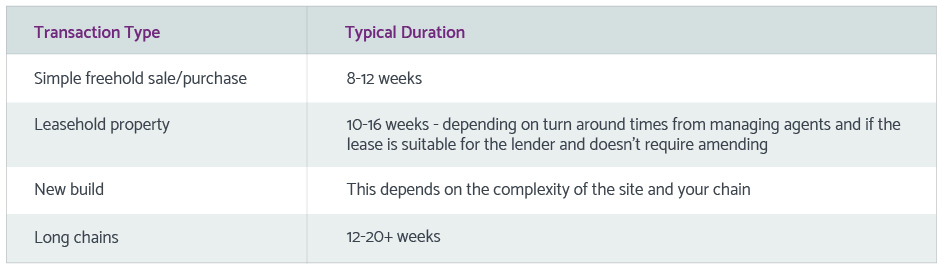
Typical Conveyancing Timeframes (guide only)
The table below outlines the typical conveyancing timeframes depending on the type of property transaction. A simple freehold sale or purchase usually takes between 8 and 12 weeks. Leasehold transactions tend to take longer, typically 10 to 16 weeks, as they often depend on managing agents’ turnaround times and whether the lease meets the lender’s requirements or needs to be amended.
New build purchases do not have a fixed timeframe, as the duration depends on the complexity of the development and the position of the property chain. Transactions involving long chains generally take the longest, often lasting 12 weeks or more, due to the additional coordination required between multiple parties.
How Thornton Jones Solicitors can Help with your Property Purchase
Our conveyancing team keeps you updated at every stage of the conveyancing process. We coordinate with mortgage lenders and other solicitors in the chain, and we proactively manages all enquiries to avoid unnecessary delays. Good communication is key to a smoother transaction.
Even though conveyancing times vary, understanding the factors at play can reduce stress and help you plan your move with confidence.
Whether you’re a first-time buyer or an experienced investor, we provide clear, proactive advice so you can move forward with confidence. Contact us today on 01924 290 029 or via our online enquiry form to speak with a solicitor who will handle your purchase efficiently and securely.
Conveyancing FAQs
Knowing the conveyancing process is crucial, whether you are a first-time buyer or a seasoned investor. The process typically involves three stages: pre-contract, exchange of contracts, and completion. Thornton Jones Solicitors recommend seeking professional guidance at each stage to ensure a smooth and legally secure transaction.
Conveyancing involves a lot of detailed work, yet fees are relatively low, making it a high-volume business. Delays often occur because solicitors are managing a large number of cases at once. Thornton Jones Solicitors advise keeping in regular contact with your conveyancer to stay updated throughout the process.
Delays can occur for various reasons, such as slow responses from buyers, sellers, or mortgage providers, or issues uncovered during searches. Thornton Jones Solicitors recommend proactive communication and early preparation to help minimise delays and keep your property transaction on track.




The content of this blog post is for information only and does not constitute formal legal advice and should not be relied upon as advice. Thornton Jones Solicitors Limited accepts no liability for any such reliance upon this content. Where the post includes links to external websites, Thornton Jones Solicitors Limited accepts no responsibility for the content of such sites. Any link to a third-party website should not be construed as endorsement by Thornton Jones Solicitors Limited of any content, products or services which are outside our direct control.
Contact our Conveyancing Solicitors in Garforth, Leeds
Thornton Jones Solicitors
Westbourne House
99 Lidgett Lane
Garforth
Leeds
LS25 1LJ
Tel: 0113 246 4423
Fax: 0113 831 4929
Email: enquiries@thorntonjones.co.uk
Contact our Conveyancing Solicitors in Wakefield
Thornton Jones Solicitors
Bank House
1 Burton Street
Wakefield
WF1 2GF
Tel: 01924 290029
Fax: 01924 290240
Email: enquiries@thorntonjones.co.uk
Contact our Conveyancing Solicitors in Ossett, Wakefield
Thornton Jones Solicitors
25 Bank Street
Ossett
WF5 8PS
Tel: 01924 586466
Fax: 01924 290240
Email: enquiries@thorntonjones.co.uk
Contact our Conveyancing Solicitors in Sherburn in Elmet, Leeds
Thornton Jones Solicitors
6 Finkle Hill
Sherburn in Elmet
Leeds
LS25 6EA
Tel: 01977 350500
Fax: 0113 831 4929
Email: enquiries@thorntonjones.co.uk
Why Do Conveyancing Clients Need to Provide ID?

In the process of buying or selling property, one of the first things we will ask for is proof of your identity. Requesting ID is not just standard practice, it’s a legal requirement that protects everyone involved in the transaction.

The primary reason ID is required is compliance with Anti-Money Laundering (AML) regulations. Law firms and conveyancers are legally obligated to verify the identity of their clients to prevent money laundering, fraud, and other criminal activities.
Why ID Checks Are Essential in Property Transactions
Buying or selling property is one of the most common ways illicit funds are “cleaned.” Criminals may attempt to use property transactions to legitimise money obtained through illegal means. To combat this, legal professionals must perform due diligence to ensure their clients are who they say they are and that the funds involved come from legitimate sources. Fraudsters can pose as property owners to illegally sell or mortgage a property they don’t own. This is especially common with vacant properties, tenanted properties, properties without a mortgage and elderly or vulnerable property owners.
The Legal Requirement for ID Checks in Property Transactions
By verifying your ID, conveyancers reduce the risk of fraudulent transactions. This protects not only their clients but also the integrity of the wider property market.
As part of their professional obligations, solicitors and conveyancers must carry out client due diligence, which includes verifying your identity, understanding the source of funds and assessing the nature of the transaction.
Without proper ID verification we cannot proceed with your matter — not only because it would be a breach of regulation, but because it could potentially facilitate criminal activity.
For all parties involved, ID verification adds transparency to the process. It’s a reassurance that everyone involved is genuine, and that the transaction is being conducted properly.
Typically, the ID you will need to provide are:
- one form of photographic ID (eg Passport or Driving Licence)
- one proof of address (eg utility bill, bank statement, council tax bill — dated within the last 3 months).
These can all be provided via an electronic ID verification app which is simple and easy to use.
Providing ID might feel like a formality, but it plays a vital role in protecting you, your property, and the entire conveyancing process. These checks are not designed to make things difficult — they are there to ensure that property transactions are secure, transparent, and compliant with the law.
Contact us for Residential Conveyancing Advice
Need expert guidance on your property transaction? Contact our residential conveyancing team today for personalised advice on 01924 290 029, or contact us using our online enquiry form.
Residential Conveyancing FAQs
Solicitors must check your identity to comply with Anti-Money Laundering (AML) regulations. This helps prevent fraud, money laundering, and protects all parties in a property transaction.
Typically, you’ll need a government-issued photo ID (like a passport or driving licence) and proof of address (such as a utility bill or bank statement). Your solicitor will confirm the exact requirements.
No. ID verification is a legal requirement. Delaying it can slow down your property transaction and may even prevent the sale or purchase from completing.
Most ID checks are quick and can be completed within a day if you provide the required documents promptly. Delays usually occur if documents are missing, unclear, or need further verification.
Yes. Under UK law, all conveyancing transactions must include identity verification to comply with Anti-Money Laundering regulations, regardless of property type or value.
Your solicitor may request additional documents or refuse to proceed until compliant ID is provided. Using outdated or incorrect documents can delay the transaction or create legal complications.
The content of this blog post is for information only and does not constitute formal legal advice and should not be relied upon as advice. Thornton Jones Solicitors Limited accepts no liability for any such reliance upon this content. Where the post includes links to external websites, Thornton Jones Solicitors Limited accepts no responsibility for the content of such sites. Any link to a third-party website should not be construed as endorsement by Thornton Jones Solicitors Limited of any content, products or services which are outside our direct control.
Contact our Residential Conveyancing Solicitors in Garforth, Leeds
Thornton Jones Solicitors
Westbourne House
99 Lidgett Lane
Garforth
Leeds
LS25 1LJ
Tel: 0113 246 4423
Fax: 0113 831 4929
Email: enquiries@thorntonjones.co.uk
Contact our Residential Conveyancing Solicitors in Wakefield
Thornton Jones Solicitors
Bank House
1 Burton Street
Wakefield
WF1 2GF
Tel: 01924 290029
Fax: 01924 290240
Email: enquiries@thorntonjones.co.uk
Contact our Residential Conveyancing Solicitors in Ossett, Wakefield
Thornton Jones Solicitors
25 Bank Street
Ossett
WF5 8PS
Tel: 01924 586466
Fax: 01924 290240
Email: enquiries@thorntonjones.co.uk
Contact our Residential Conveyancing Solicitors in Sherburn in Elmet, Leeds
Thornton Jones Solicitors
6 Finkle Hill
Sherburn in Elmet
Leeds
LS25 6EA
Tel: 01977 350500
Fax: 0113 831 4929
Email: enquiries@thorntonjones.co.uk